Claims 1–19 from the public U.S. application text, source pages 37–42. Warten has been allowed and its issue fee paid; this is not an issued patent.
Searchable claim text
Reading aid produced by PDF text extraction. The original page images and PDF below preserve the source layout and wording.
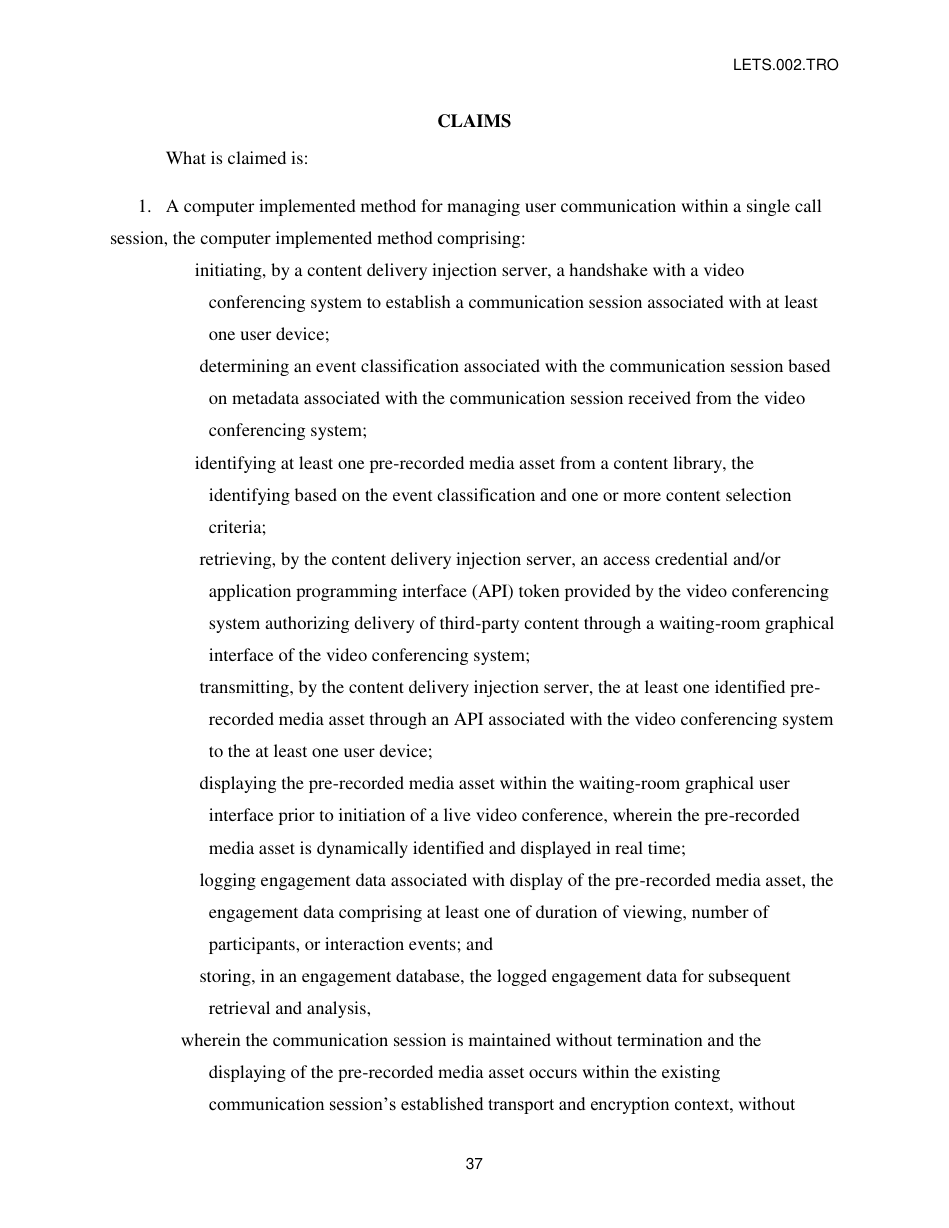
CLAIMS
What is claimed is:
1. A computer implemented method for managing user communication within a single call
session, the computer implemented method comprising:
initiating, by a content delivery injection server, a handshake with a video
conferencing system to establish a communication session associated with at least
one user device;
determining an event classification associated with the communication session based
on metadata associated with the communication session received from the video
conferencing system;
identifying at least one pre-recorded media asset from a content library, the
identifying based on the event classification and one or more content selection
criteria;
retrieving, by the content delivery injection server, an access credential and/or
application programming interface (API) token provided by the video conferencing
system authorizing delivery of third-party content through a waiting-room graphical
interface of the video conferencing system;
transmitting, by the content delivery injection server, the at least one identified pre-
recorded media asset through an API associated with the video conferencing system
to the at least one user device;
displaying the pre-recorded media asset within the waiting-room graphical user
interface prior to initiation of a live video conference, wherein the pre-recorded
media asset is dynamically identified and displayed in real time;
logging engagement data associated with display of the pre-recorded media asset, the
engagement data comprising at least one of duration of viewing, number of
participants, or interaction events; and
storing, in an engagement database, the logged engagement data for subsequent
retrieval and analysis,
wherein the communication session is maintained without termination and the
displaying of the pre-recorded media asset occurs within the existing
communication session’s established transport and encryption context, without

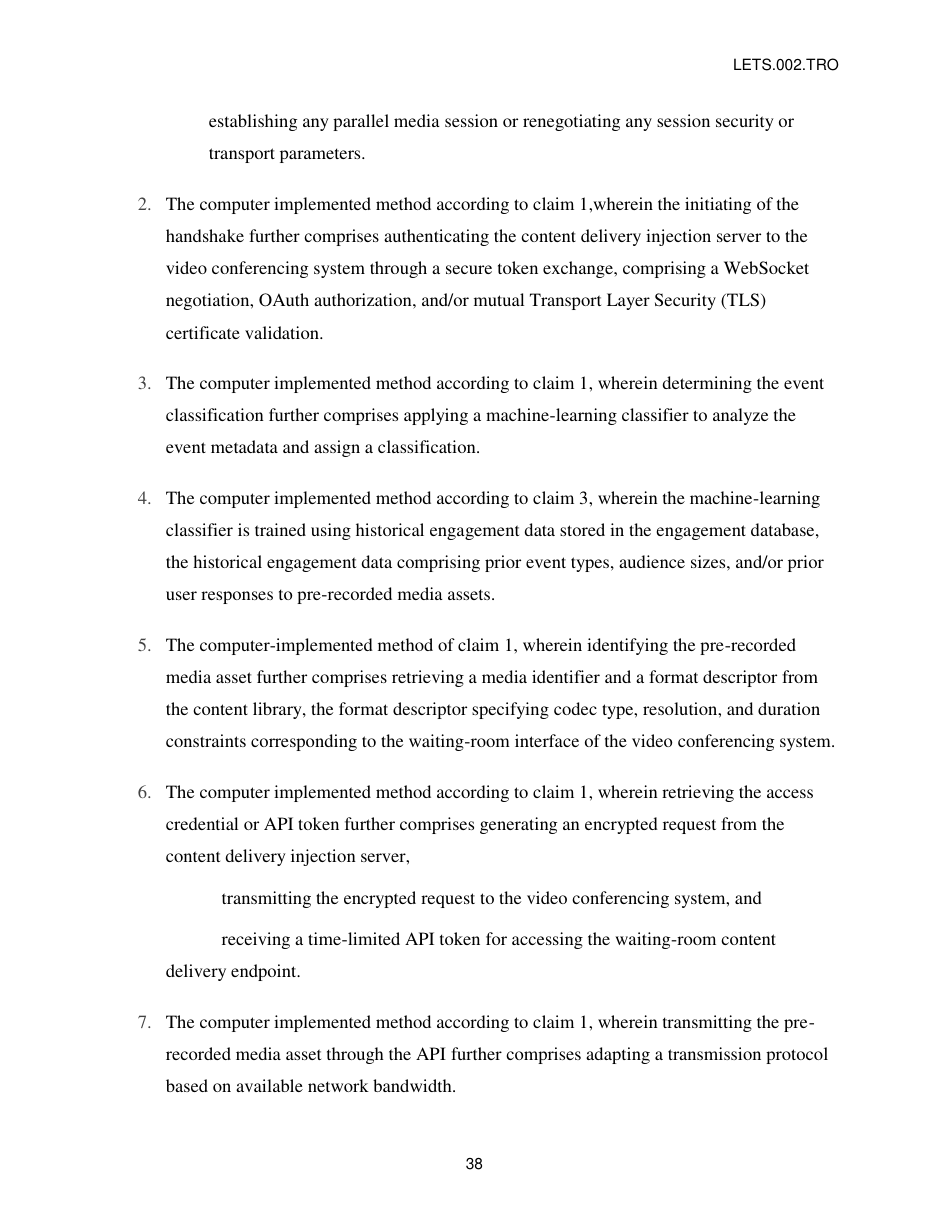
establishing any parallel media session or renegotiating any session security or
transport parameters.
2. The computer implemented method according to claim 1,wherein the initiating of the
handshake further comprises authenticating the content delivery injection server to the
video conferencing system through a secure token exchange, comprising a WebSocket
negotiation, OAuth authorization, and/or mutual Transport Layer Security (TLS)
certificate validation.
3. The computer implemented method according to claim 1, wherein determining the event
classification further comprises applying a machine-learning classifier to analyze the
event metadata and assign a classification.
4. The computer implemented method according to claim 3, wherein the machine-learning
classifier is trained using historical engagement data stored in the engagement database,
the historical engagement data comprising prior event types, audience sizes, and/or prior
user responses to pre-recorded media assets.
5. The computer-implemented method of claim 1, wherein identifying the pre-recorded
media asset further comprises retrieving a media identifier and a format descriptor from
the content library, the format descriptor specifying codec type, resolution, and duration
constraints corresponding to the waiting-room interface of the video conferencing system.
6. The computer implemented method according to claim 1, wherein retrieving the access
credential or API token further comprises generating an encrypted request from the
content delivery injection server,
transmitting the encrypted request to the video conferencing system, and
receiving a time-limited API token for accessing the waiting-room content
delivery endpoint.
7. The computer implemented method according to claim 1, wherein transmitting the pre-
recorded media asset through the API further comprises adapting a transmission protocol
based on available network bandwidth.

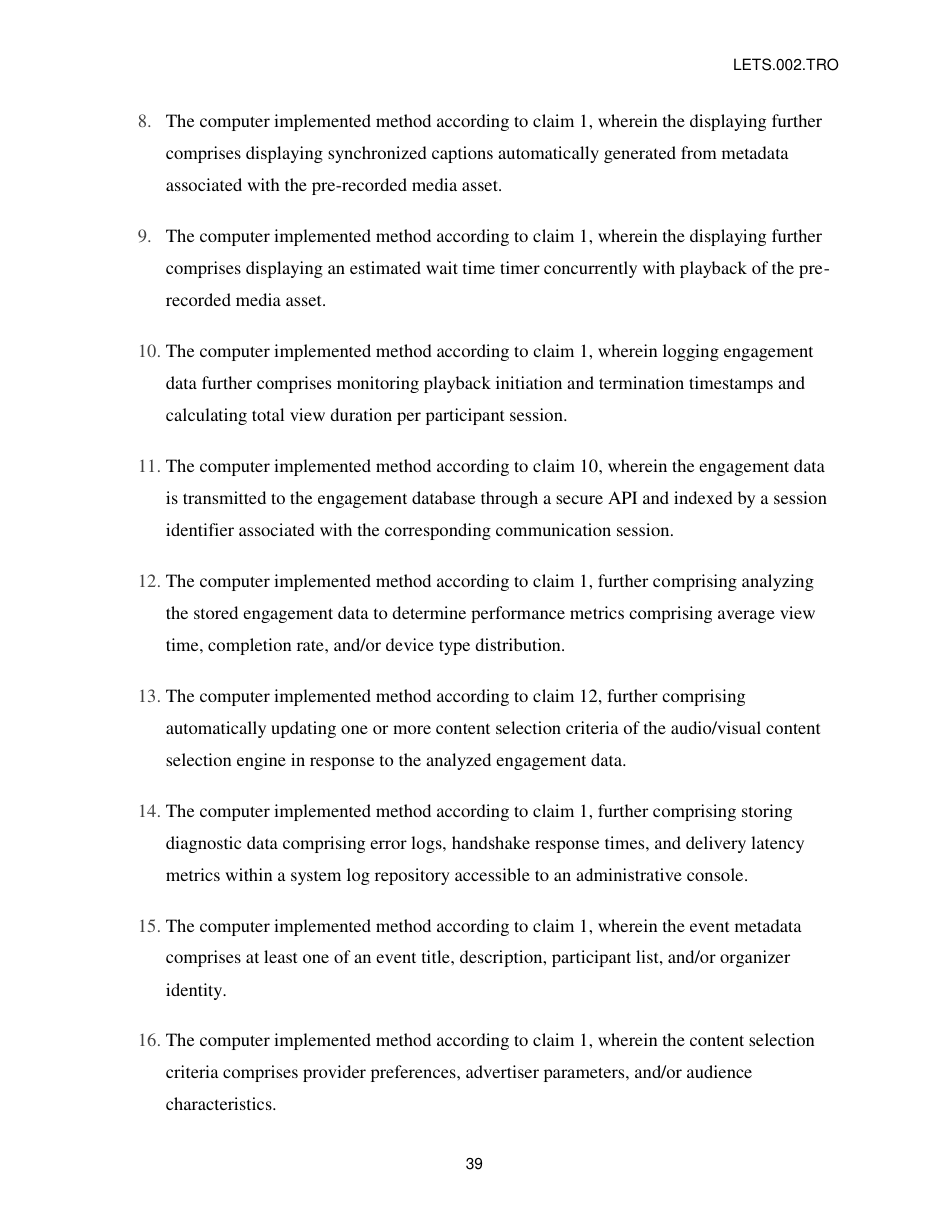
8. The computer implemented method according to claim 1, wherein the displaying further
comprises displaying synchronized captions automatically generated from metadata
associated with the pre-recorded media asset.
9. The computer implemented method according to claim 1, wherein the displaying further
comprises displaying an estimated wait time timer concurrently with playback of the pre-
recorded media asset.
10. The computer implemented method according to claim 1, wherein logging engagement
data further comprises monitoring playback initiation and termination timestamps and
calculating total view duration per participant session.
11. The computer implemented method according to claim 10, wherein the engagement data
is transmitted to the engagement database through a secure API and indexed by a session
identifier associated with the corresponding communication session.
12. The computer implemented method according to claim 1, further comprising analyzing
the stored engagement data to determine performance metrics comprising average view
time, completion rate, and/or device type distribution.
13. The computer implemented method according to claim 12, further comprising
automatically updating one or more content selection criteria of the audio/visual content
selection engine in response to the analyzed engagement data.
14. The computer implemented method according to claim 1, further comprising storing
diagnostic data comprising error logs, handshake response times, and delivery latency
metrics within a system log repository accessible to an administrative console.
15. The computer implemented method according to claim 1, wherein the event metadata
comprises at least one of an event title, description, participant list, and/or organizer
identity.
16. The computer implemented method according to claim 1, wherein the content selection
criteria comprises provider preferences, advertiser parameters, and/or audience
characteristics.

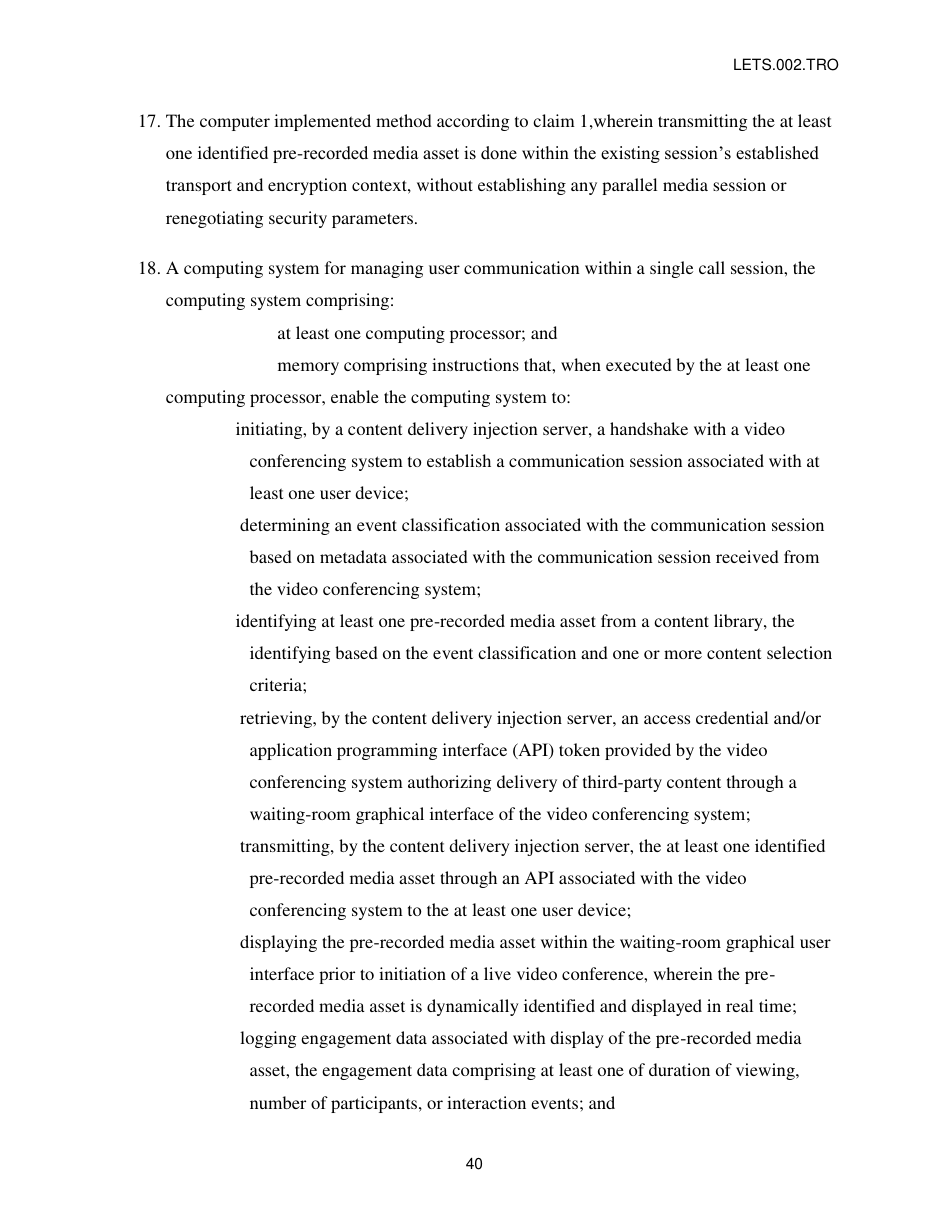
17. The computer implemented method according to claim 1,wherein transmitting the at least
one identified pre-recorded media asset is done within the existing session’s established
transport and encryption context, without establishing any parallel media session or
renegotiating security parameters.
18. A computing system for managing user communication within a single call session, the
computing system comprising:
at least one computing processor; and
memory comprising instructions that, when executed by the at least one
computing processor, enable the computing system to:
initiating, by a content delivery injection server, a handshake with a video
conferencing system to establish a communication session associated with at
least one user device;
determining an event classification associated with the communication session
based on metadata associated with the communication session received from
the video conferencing system;
identifying at least one pre-recorded media asset from a content library, the
identifying based on the event classification and one or more content selection
criteria;
retrieving, by the content delivery injection server, an access credential and/or
application programming interface (API) token provided by the video
conferencing system authorizing delivery of third-party content through a
waiting-room graphical interface of the video conferencing system;
transmitting, by the content delivery injection server, the at least one identified
pre-recorded media asset through an API associated with the video
conferencing system to the at least one user device;
displaying the pre-recorded media asset within the waiting-room graphical user
interface prior to initiation of a live video conference, wherein the pre-
recorded media asset is dynamically identified and displayed in real time;
logging engagement data associated with display of the pre-recorded media
asset, the engagement data comprising at least one of duration of viewing,
number of participants, or interaction events; and

storing, in an engagement database, the logged engagement data for subsequent
retrieval and analysis,
wherein the communication session is maintained without termination and the
displaying of the pre-recorded media asset occurs within the existing
communication session’s established transport and encryption context, without
establishing any parallel media session or renegotiating any session security or
transport parameters.
19. A non-transitory computer readable medium comprising instructions that when executed
by a processor enable the processor to execute a computer implemented method, the
method comprising:
initiating, by a content delivery injection server, a handshake with a video
conferencing system to establish a communication session associated with at
least one user device;
determining an event classification associated with the communication session
based on metadata associated with the communication session received from
the video conferencing system;
identifying at least one pre-recorded media asset from a content library, the
identifying based on the event classification and one or more content selection
criteria;
retrieving, by the content delivery injection server, an access credential and/or
application programming interface (API) token provided by the video
conferencing system authorizing delivery of third-party content through a
waiting-room graphical interface of the video conferencing system;
transmitting, by the content delivery injection server, the at least one identified
pre-recorded media asset through an API associated with the video
conferencing system to the at least one user device;
displaying the pre-recorded media asset within the waiting-room graphical user
interface prior to initiation of a live video conference, wherein the pre-
recorded media asset is dynamically identified and displayed in real time;

logging engagement data associated with display of the pre-recorded media
asset, the engagement data comprising at least one of duration of viewing,
number of participants, or interaction events; and
storing, in an engagement database, the logged engagement data for subsequent
retrieval and analysis,
wherein the communication session is maintained without termination and the
displaying of the pre-recorded media asset occurs within the existing
communication session’s established transport and encryption context, without
establishing any parallel media session or renegotiating any session security or
transport parameters.