Originally published on Thomas’s Substack. Reproduced from the supplied publication export. Statements and patent-status references reflect the original publication date.
Editorial introduction · added September 17, 2026
Before you read
The origin story brings together missed calls, illness, recovery, invention, and the author's interpretation of their timing. It explains how practical problems grew into the SSOAR family and why the work matters personally. The astrological narrative is presented as personal reflection, separate from the patent record and the technical evidence for the architecture.
SSOAR means Session-Scoped Orthogonal Authority and Routing.
Why read it?
- Readers interested in the inventor
- Understand the experiences and questions that shaped the work.
- Prospective collaborators
- Read the personal context alongside the separate technical and commercial material.
This introduction is separate from the original essay.
Go to the original essay ↓The dates in this essay are public record. I drew the medical events from my records and recollection. The astrological meaning is my interpretation of the pattern they form. My treatment decisions are part of my personal history, not medical advice.
The Call
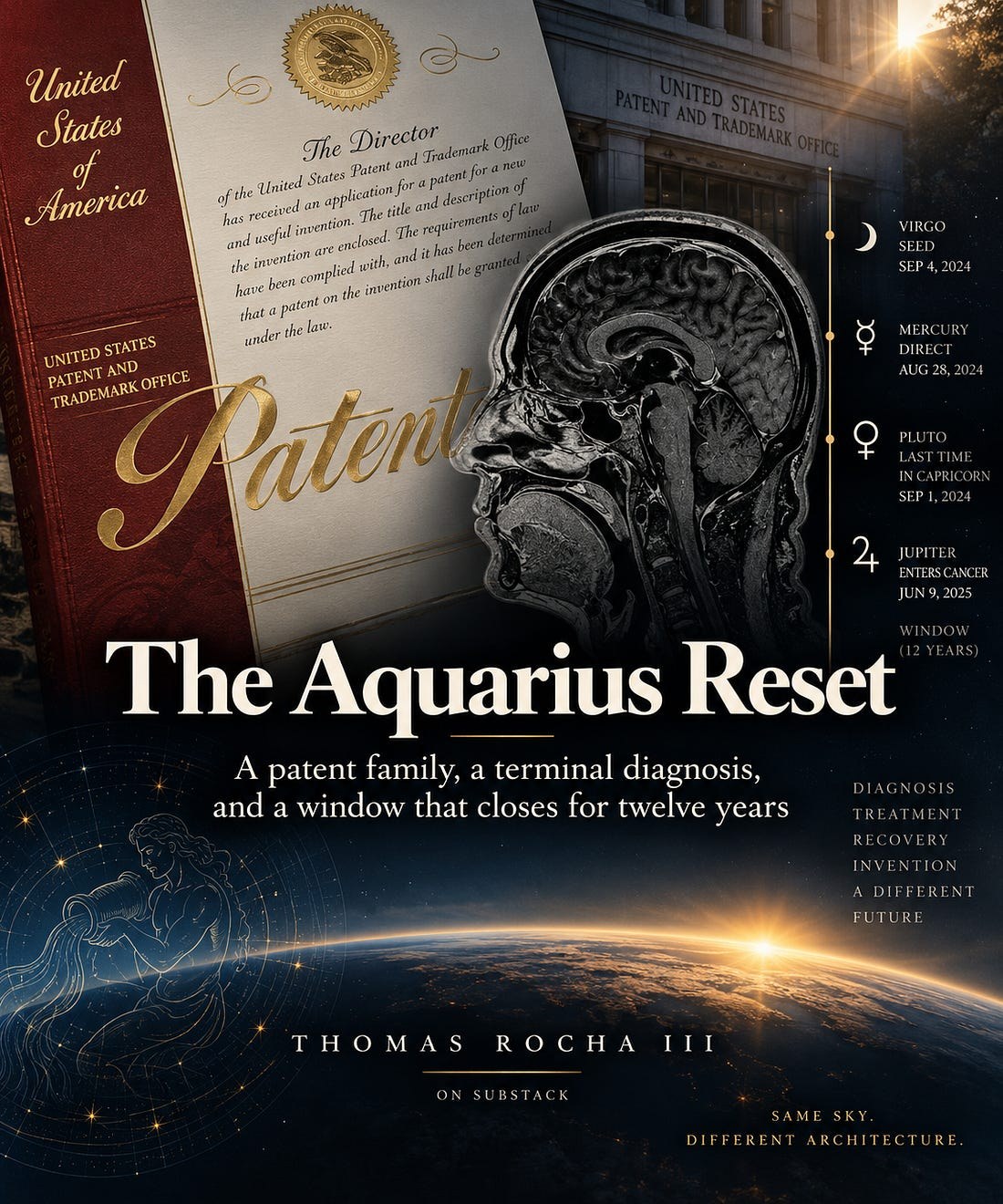
I wanted to see Koni’s face.
That is where this begins. I called Koni over FaceTime. Koni did not pick up, and the screen went to nothing. No message, no image, no presence. At the exact moment the connection failed, a video medium offered me less than a telephone did in 1970.
I had been diagnosed with inoperable Stage III non-small cell lung cancer in August 2019. By the time I made that call, I was carrying a second diagnosis: leptomeningeal carcinomatosis, a Stage IV brain cancer with a prognosis measured in months. My reaction was not a product observation. It was closer to an insult. I did not know how many more chances I would have to see the people I cared about. The machine should have been a chance. It wasn’t.
That seemed stupid.
Two things followed immediately. I was not thinking strategically.
The first was accessibility. If the medium is visual, then signing is in play. Not as a compliance obligation, not as a request from legal, but as an obvious property of the thing itself. You cannot take a visual channel seriously and treat sign language as an accommodation bolted on afterward. It was in the design from day one,
The second was the dead time. I was in sales, living in online conference call rooms and watching the empty minutes before meetings started. Same reaction: this is dumb. The channel is open, and nothing is happening in it. Put something there. A message from the host. Cat videos. And since I sell for a living, capture the lead while you’re at it: CRM hooks, an ad exchange, and a structured record of who showed up and what they said.
None of this was architecture to me. I kept encountering systems that had the information and capability to act, but no authority governing the moment. I was repeatedly annoyed by the same kind of stupidity and tried to fix it three times.
The Seed
Before the filing, there was a decision and then a recovery.
In early July 2023, I met with a radiation oncologist. He recommended whole-brain radiation. My regular oncologist agreed. I declined.
I understood the argument. It might buy time. But what was the point of hanging around if I was not me?
I began lorlatinib on October 6, 2023. By January 2024, the disease was undetectable. The provisional was filed on September 4, 2024. Decision, treatment, recovery, invention, in that order.
September 4, 2024.
The provisional is filed with the USPTO. It describes the first fix: the receiver records a message in advance, the system plays it when the call goes unanswered, the caller can reply, and the whole exchange happens inside one session that never tears down and rebuilds.
Two days earlier, the New Moon fell in Virgo.
Virgo is the sign of systems, of syntax and logistics and the unglamorous work of finding the broken thing in the pipe. A New Moon is a seeding point, and the days just after it are what practitioners call the action window. Filing a patent about a small broken thing in the plumbing, in that window, is a coincidence you notice and put away.
The week around it carries two other marks.
Mercury was stationed direct on August 28 and was moving forward again in Leo. Mercury direct after retrograde is the traditional signature for communication resuming; Leo makes it declarative. A statement spoken out loud after a period of not being able to speak.
On September 1, Pluto retrograded into Capricorn for the last time in this lifetime. Pluto takes 248 years to circle the Sun and had been moving through Capricorn, the sign of institutions and established hierarchy, since 2008. That September it crossed back to finish its final degrees. It will not return in the life of anyone now alive.
The old architecture taking its final breath. And on the fourth of that month, someone files a piece of the replacement without knowing that is what it is.
The Window Opens
June 9, 2025.
Nothing happens. No filing, no publication, no decision. This date belongs to the sky alone, and it is the most important astrological fact in this document.
Jupiter enters Cancer.
Cancer is Jupiter’s exaltation, traditionally its strongest and most favorable placement. Jupiter represents law, expansion, legitimacy, and the granting of standing. Cancer represents memory, foundation, and the things held and protected.
Jupiter stays there roughly twelve and a half months. It crosses into Leo at the end of June 2026 and does not return to Cancer until 2037.
Hold that window open. Everything that follows happens inside it.
The Pattern
Mid-November 2025.
The second invention, the one that fills the dead time before a meeting, is being converted from provisional to non-provisional. The work of conversion is the work of differentiation: you have to say precisely what this is that nothing else is.
Stress-testing it, I noticed that the existing system sent captions to everyone.
Same reaction. That’s stupid.
Not stupid because captions are bad. Stupid because broadcasting captions to every participant is a blunt instrument where the problem calls for a negotiation, and because it breaks entirely the moment you introduce AI avatar signing. If the accommodation is per-participant, the system has to know who needs what and decide accordingly, before and during the session. Captions-to-all is not a small implementation flaw. It is the wrong shape.
So I stopped. Mid-conversion, with a live filing underway, I put that work down and went to work on the third thing: accessibility negotiation as a session primitive. It became Ludwig’s Raven, named for Ludwig van Beethoven, who wrote the Ninth Symphony after he had gone deaf. Communication routed around the broken channel instead of being abandoned when the channel failed.
Then I returned to the conversion with all three inventions in front of me.
Hermes alone is a better voicemail. Warten alone is a nicer waiting room. Ludwig’s Raven alone is an accessibility feature. Two of them give you two products. With three in view, the common thing underneath becomes undeniable: each is about what the session knows, who holds authority inside it, and when that authority is established. The thing I had fixed three times was one thing.
I named the architecture inside the second utility. Only then did its size become clear.
What the sky was doing
Jupiter stationed retrograde in Cancer on November 11, 2025. Days before.
A retrograde planet is the traditional signature for review: going back over ground already covered and finding what was missed the first time. Not new acquisition. Re-reading.
That is what happened. I did not invent three new things in November. I looked again at work already filed and saw one architecture. In the astrological reading, the planet of law was exalted in the sign of memory and turning back to re-examine what was already held.
Saturn and Neptune had both retrograded back into the final degrees of Pisces. They had touched Aries earlier in 2025, then reversed, and spent the close of the year finishing their passage through the last sign of the zodiac. Pisces is the undifferentiated field, the place where things have not yet separated into distinct forms.
The pattern surfaced while structure and vision were both still in the water.
The Forced Conclusions
December 8, 2025.
Seven more inventions were filed. I called them forced conclusions once the architecture was clear, consequences rather than separate creative acts. If the primitive is real, these functions must exist inside it.
The Sun is in Sagittarius.
Sagittarius is the sign of synthesis, the move from particular instances to a general law. It is ruled by Jupiter, which was then retrograde and exalted in Cancer.
Seven patents were filed in one day as consequences of a governing principle, under the sign associated with that exact move.
The Emergence
January 1, 2026.
Pluto crossed into Aquarius for good in November 2024. Aquarius rules networks, distributed systems, and the mesh rather than the tower. January 1, 2026 was the first day of the first complete calendar year under that transit. No one selected that anniversary. It was simply the arithmetic of a calendar and an orbit.
On that day the first patent publishes in the United States. Hermes- Echo.
The Sun was in Capricorn, and the publishing body is a distinctly Capricorn institution: an office that converts ideas into durable, enumerated public records. Two days later, the Full Moon lit Cancer, completing the axis between institutional structure and foundational memory.
Hermes-Echo is Asynchronous Session Memory.
Memory is Cancer’s domain, and Jupiter is sitting in it.
The Hardening
February 20, 2026.
Saturn and Neptune met at zero degrees of Aries, the origin point of the zodiac. Saturn represents structure and the hard edge of the enforceable. Neptune represents the formless and not-yet-real. Their conjunction carries the traditional reading of the hardening of the ethereal: something imagined acquiring binding form.
They finish the journey through Pisces they were making in November, when the pattern first came into focus, and they cross the line together.
March 3, 2026. Total lunar eclipse, a Blood Moon, in Virgo.
Solar eclipses plant; lunar eclipses reveal. This one fell in the sign of systems and debugging. In the traditional reading, its result would emerge during the following weeks rather than on the night itself.
March 12, 2026. Nine days in.
Two things happen at once. Hermes-Echo publishes internationally through WIPO, the moment a US application stops being an American document and becomes a fact of the world. And the same day, the second patent publishes domestically: Warten, German for to wait, the one that fills the dead time and establishes context before the session opens.
The Sun is in Pisces.
Pisces is the universal field, the sign of boundaries dissolving, of the drop returning to the ocean. WIPO publication is a boundary dissolving: one jurisdiction becoming all of them. The signal entering the field, under the sign that rules the field.
And Pisces is the sign of waiting. Of the pre-formal. Of potential suspended before it takes shape.
The patent named to wait, publishing under the sign of waiting.
The Reception April 7, 2026.
Notice of Allowance for Hermes-Echo. The examiner allowed all twenty claims.
The Sun sits near seventeen degrees of Aries, having already passed Saturn and Neptune in the early degrees of that same sign. Identity and visibility moving out ahead of the structural transformation instead of trailing behind it.
Mercury is in Aries beside the Sun, at or very near cazimi.
Cazimi means “in the heart” and describes a planet within sixteen minutes of arc of the Sun’s center. A nearby planet is traditionally considered combust and weakened. At the center, that reading reverses: the planet is admitted to the throne room and granted an audience with the king.
Mercury is Hermes.
The patent named for the Messenger is validated on the day the Messenger is received.
The Crossroads
April 30, 2026.
A continuation is filed. Same disclosure as the parent, new claims. The old claims spoke of video voicemail servers and caller devices. The new ones speak of session controllers, session context, rule data, endpoints, and entities. Nothing was added to the specification. The abstraction had been sitting in it the whole time; the continuation reaches in and names it.
This is the moment the thing stops being a product and becomes a primitive.
It is called Hermes-Hecate, and April 30 is Walpurgis Night, the eve of Beltane, one of the four cross-quarter hinges of the old European year. In the Western esoteric tradition, it belongs to Hecate more completely than any other night.
Hecate holds a position in Greek myth that no other figure holds.
When the Olympians overthrew the Titans, the Titans were destroyed, imprisoned, or absorbed. That is the point of a new order: the old power is extinguished or made subordinate. Every Titan in the mythology meets one of those ends.
Except her. Hesiod records it plainly. Zeus honored Hecate above all others and left her domains intact, her share of earth and sea and sky untouched. She was not folded into the hierarchy and she was not crushed by it. She governed alongside it.
Her authority was orthogonal to the ruling structure.
The framework this family implements is called SSOAR: Session-Scoped Orthogonal Authority and Routing. The word orthogonal is not decoration, it is the entire argument. Session governance has to sit outside the application layer and outside the routing layer, answerable to neither, or it cannot govern anything at all.
The continuation that states that claim in its most abstract form is named for the one figure whose authority worked exactly that way, and it is filed on her night.
Its sixteenth claim holds that the session controller maintains context independent of variations in execution timing, processing order, or determinism of the components participating in the session, including cases where those components produce non-deterministic or probabilistic outputs.
In plain language: the boundary holds no matter how unpredictably the things inside it behave.
That is the AI governance claim. It is also a precise description of how Hecate’s authority functioned. Whatever happened inside the domains she guarded, her standing at the threshold did not change.
The Wait Ends
May 19, 2026.
Warten is allowed. As drafted.
The Sun sat at twenty-eight degrees of Taurus. The final degrees of a sign are called anaretic, or critical. Taurus at twenty-eight represents ownership and material structure compressed into the final moments before the handoff.
Note the order. Hermes-Echo published, went international, and was allowed. The continuation was filed and the crossroads opened. Only then, with everything else standing, does the patent named to wait receive its approval.
It was the last of the pair to be validated. It waited until its name was true.
The Grant
June 16, 2026.
Hermes-Echo issues as United States Patent No. 12,659,408. Not published. Not allowed. Granted, and enforceable.
The Sun is in Gemini. Gemini is ruled by Mercury. Mercury is Hermes.
The patent named for the god becomes law under the sign the god rules. Not in a neighboring window, not by loose association: in his own house, presiding over the moment his name acquires legal force.
And Jupiter is still in Cancer, in the final degrees, two weeks from crossing into Leo and beginning a twelve-year absence.
A memory-architecture patent becomes enforceable law while the planet of law sits exalted in the sign of memory, in the last days it will hold that position until 2037.
The Full Moon two days earlier fell in Sagittarius, the sign of law and higher truth, lighting that axis across from the Gemini Sun. The solstice follows four days later: maximum light, the longest day, the top of the year.
The patent enters full legal force while the light is still rising.
One day earlier, on June 15, 2026, I reached three years from my diagnosis of leptomeningeal carcinomatosis. The original prognosis had been measured in months. The patent governing continuity across interruption entered legal force one day after I crossed a survival threshold that prognosis did not contemplate.
The Window Closes
Late June 2026.
Jupiter leaves Cancer.
Now look at what sat inside that transit.
The pattern recognized in mid-November 2025, days after Jupiter stationed retrograde in the sign of memory. The seven filings on December 8, under Jupiter’s own sign. The US publication on January 1. The WIPO and Warten publications on March 12. The allowance on April 7. The continuation on April 30. Warten’s allowance on May 19. And the grant on June 16, with two weeks to spare.
Every event from the moment the architecture became visible to the moment it became enforceable law happened inside a single passage of Jupiter through its exaltation.
The provisional in September 2024 falls outside the window on one end. The continuation’s publication falls outside on the other. Everything that constitutes the architecture becoming real is contained between the opening and the closing.
Twelve and a half months. Once in twelve years.
The Return
September 10, 2026.
Hermes-Hecate publishes as US 2026/0270347 A1. The Sun is in Virgo, the New Moon window open.
Two years and six days earlier, in the action window of a Virgo New Moon, a provisional was filed describing a video voicemail system. It began with one call: I wanted to see my friend’s face.
Now, in the action window of another Virgo New Moon, the abstraction of that same disclosure enters the public record, and what enters is not a video voicemail system. The claims describe a session-continuity primitive with no application attached to it at all.
Virgo is the sign of analysis in its literal sense: taking something apart and separating the essential from the incidental, the mechanism from the first product that happened to contain it.
That is precisely what the continuation does to its parent. It dismantles the concrete system and names the primitive that was inside it from the beginning.
The architecture was seeded in Virgo. Two years later its own abstraction returns in Virgo. The cycle closes where it opened, and what comes back is no longer a product.
The Family
Ten coordinated inventions, a single patent family. Three form the invariant state, the black box.
Hermes-Echo holds session memory across interruption. Warten loads context before anything begins, establishing what continuous verification means. Ludwig’s Raven, named for Ludwig van Beethoven, makes accessibility a negotiation rather than a broadcast and has a priority deadline of October 22, 2026. These three cannot be toggled off, reconfigured, or routed around. Hermes-Hecate extracts their governing logic and states it in the abstract.
Seven govern inside that state, with publication anticipated together in June 2027.
Muninn, Odin’s raven of Memory, coordinates AI inference within session governance. The session holds the model’s context rather than trusting the model to hold it. Quetzalcoatl, the Plumed Serpent bridging earth and sky, handles sessions that merge, fork, cascade, and hand off. Zhinü, the Weaver Goddess, weaves IoT, XR, robotics, and telemetry into one governed session despite their different languages.
Lakshmi arbitrates compute across cost, latency, and availability. The Griot handles provenance through attestation chains that preserve what happened and how it came to be known. Hari Seldon, Asimov’s mathematician who prepared for an empire’s fall, enforces data residency deterministically without a human deciding otherwise.
And Deganawida, the Great Peacemaker of the Haudenosaunee, handles continuous trust attestation.
The last name explains the rest. In the Great Law, peace does not come from goodwill, because goodwill is unreliable and people are people. Peace comes from building a structure so sound that violation stops being available as an option.
That is the design intent: make the environment itself trustworthy so policing becomes unnecessary.
If the Trinity holds as an invariant, the Seven cannot be turned against their purpose. Humans remain stewards rather than administrators: no override, no root, no god mode. This is the stated design intent, not a claim already proven in the field. The aim is to make digital malpractice structurally unavailable, not merely forbidden.
What to Make of It
The gap was findable. It probably would have been found.
Merton spent a career arguing that the singleton discovery, the one only a particular person could have made, is the exception rather than the rule. Calculus twice. Natural selection twice. The telephone by hours. An idea becomes available, and several hands reach for it. Session authority as a layer distinct from transport is not hidden; it is a gap sitting in the open, and enough people are staring at distributed systems that someone was going to name it.
But availability and framing are different problems.
I spent my Navy years as an Ocean Systems Technician, listening to the Atlantic through a distributed sensor array. I learned that a contact’s identity is something you maintain across handoffs between listening stations, not something you simply have.
I did not build the foundational inventions alone. The patent record names the co-inventors who contributed. I later recognized that the three expressed one invariant and that seven additional functions followed from it. Contributing to an invention and seeing the architecture across a family are different acts. Both can be true without diminishing either.
I was given a terminal diagnosis, followed by a second one. The disease and its treatment disrupted my short-term memory, executive sequencing, and language retrieval. They disrupted my session state. I used external infrastructure to preserve context across the gaps in my own continuity, and I documented myself doing it.
Then I built an architecture whose single thesis is that identity must persist across interruption, context must be established before the session opens, and the boundary must hold regardless of what happens inside it.
You cannot see a system’s architecture while it is working. Function hides structure. The only reliable way to learn what something is made of is to watch it fail, and the only way to watch it fail from the inside is to be the thing that is failing.
I did not derive the primitive. I accumulated instances until it surfaced: three points, the minimum required to define a plane. I had three because I kept following the same small reaction in different rooms. That’s stupid. The system had the information and capability to act, but did nothing because nobody had decided who was in charge of that moment.
Somebody else probably would have found the gap. But they would not have reached it through SOSUS, disrupted memory, or my need to see a friend’s face while I believed I was dying. Whatever they built would have had a different shape.
Every date in this document was set by an examiner’s queue, a printing schedule, or a statutory deadline. I chose none of them.
I chose the names. Hermes, because the thing carries messages. Hecate, because it stands at a crossroads. Warten, because it waits.
I did not time the stars. The stars, apparently, timed themselves.
There are more things in heaven and earth, Horatio, Than are dreamt of in your philosophy.
William Shakespeare Hamlet, Act 1, Scene 5