Originally published on Thomas’s Substack. Reproduced from the supplied publication export. Statements and patent-status references reflect the original publication date.
Editorial introduction · added September 17, 2026
Before you read
The inventor's commercial introduction explains how the portfolio grew from specific communication problems into a broader argument about governing live interactions. It connects SSOAR's technical premise to licensing and stewardship: the proposed economic unit is an authorized event within a continuing session. Read it for the owner's intentions and commercial framing, alongside the actual patent record when evaluating rights.
SSOAR means Session-Scoped Orthogonal Authority and Routing.
Why read it?
- Potential licensees and strategic buyers
- Understand the intended commercial relationship and the questions to bring to diligence.
- Investors
- See how the inventor connects the family of inventions to a proposed market position.
This introduction is separate from the original essay.
Go to the original essay ↓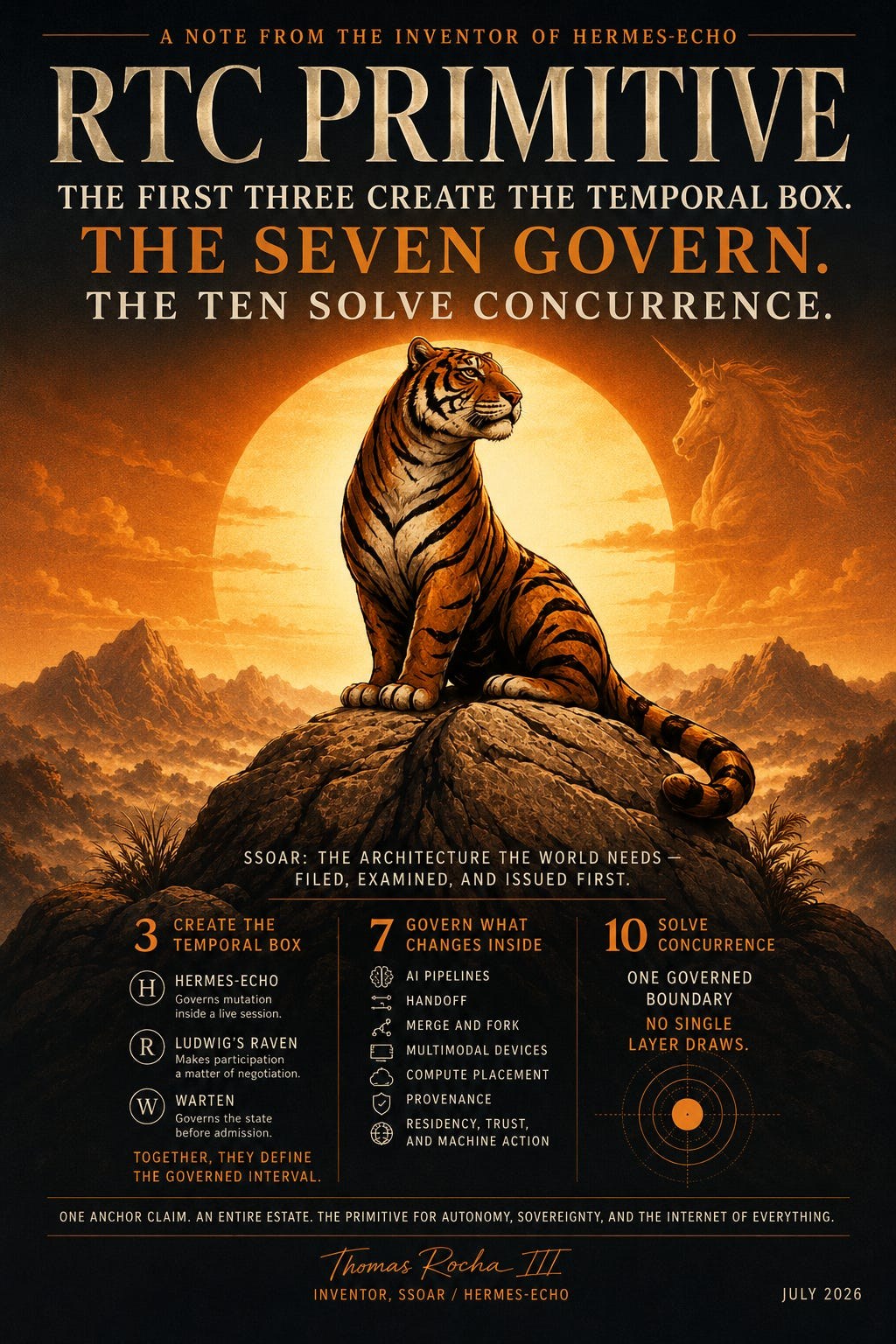
I am going to say this plainly.
This is a primitive. It is a unicorn.
The closest historical analog is Bell: one anchor claim riding existing infrastructure. Bell captured the voice over the telegraph infrastructure. Hermes-Echo captures session authority over existing protocol infrastructure. The difference is that Bell did not file the surrounding architecture himself. I did.
The market is just now identifying the problem. The solution is already here, already filed, and already examined and issued in its first embodiment.
It did not start as an academic theory. It started with practical business problems. I was trying to solve live communication failures that should not have existed. Once I found the pattern, it was bigger than video calls.
The rule is 3-7-10.
The first three filings create the temporal box. I was the chief inventor on those three.
Hermes-Echo governs mutation inside a live session.
Ludwig’s Raven makes participation itself a matter of negotiation.
Warten governs the state before admission.
Together, they define the governed interval.
The seven remaining filings govern what changes inside that box. I am the sole inventor on those seven. They cover the authority changes that now break distributed systems: AI pipelines, handoff, merge and fork, multimodal devices, compute placement, provenance, residency, trust, and machine action.
All ten solve concurrence.
That is the point. The world is not failing because one thing changes. It is failing because everything changes at once. Identity changes. Policy changes. Compute changes. Trust changes. Residency changes. Accessibility changes. Provenance changes.
Existing systems try to reconcile those changes after the fact. SSOAR binds them during the live interaction while it is still happening.
Three create the temporal box.
Seven govern the contents.
Ten solve concurrence.
That is how the architecture works.
The economic argument is just as direct. SSOAR makes the governed session the unit of value.
Hermes-Echo captures intent that used to fall out of the interaction. Warten admits attention that used to sit beside the interaction. Ludwig’s Raven makes accessibility a governed participation surface inside the interaction. The seven remaining filings extend the same economic logic across AI, compute, trust, provenance, residency, accessibility, and machine action.
The money is not just in ads, leads, tokens, minutes, records, or impressions. Those are fragments.
The money is at the governed crossing: the moment something enters, acts, routes, computes, proves, records, or settles inside a live authority boundary. That is the economic choke point.
Existing systems can count fragments. They can count clicks. They can count impressions. They can count tokens. They can count calls. They can count records.
What they cannot do coherently is close the governed session event where authority, value, cost, proof, risk, and settlement meet.
SSOAR does that.
The patent estate sits where the fragments have to become one governed economic event.
That is why this is not merely defensive IP. It is not just a feature bundle. It is not video voicemail, waiting-room ads, accessibility tooling, AI routing, compliance software, residency routing, compute placement, provenance, or trust management.
Those are embodiments and surfaces.
The primitive is deeper.
It does not require a new protocol. It does not require new hardware. It works with what is already deployed.
I do not believe you can build the Internet of Everything, real machine autonomy, or the quantum internet on today’s fragmented architecture. I believe you can build them on this.
That is the unicorn case.
Not a company valuation label. Not startup language. A communications-primitive event.
One anchor claim on existing infrastructure. A full estate around the commercial and governance space. Filed before the market fully named the problem. Examined in its first embodiment. Built in the same window in which the industry began to realize fragmented authority cannot carry what is coming next.
The portfolio is too foundational to be misunderstood, too broad to be stranded, and too valuable to be treated as a single feature acquisition.
The structure has to match the primitive.
I am also working under a personal timeline. I have been diagnosed with terminal brain cancer. This does not change what the architecture is or what it is worth. It does change my capacity to lead its stewardship, and it clarifies why the right structure has to be established while I am still able to shape it.
The portfolio is continuation-friendly. It will grow. I intend to use the PCT path wherever it makes sense.
Every day, the world moves deeper into autonomy, AI coordination, data sovereignty, pressure for accessibility, trust failures, and machine- to-machine systems.
Every day, this gets more valuable.
That is how the cow eats the cabbage.
Thomas Rocha III