Originally published on Thomas’s Substack. Reproduced from the supplied publication export. Statements and patent-status references reflect the original publication date.
Editorial introduction · added September 17, 2026
Before you read
Identity, routing, memory, payment, and accessibility each describe a function. This essay asks what shared object those functions should govern. Its answer is the continuing, bounded interaction in which they change. That is the central SSOAR thesis and its breadth: agents are one kind of participant, while the proposed primitive concerns the whole undertaking and the authority that remains binding throughout it.
SSOAR means Session-Scoped Orthogonal Authority and Routing.
Why read it?
- Systems architects
- Consider the interaction itself alongside the functional decomposition of the system.
- Investors and prospective licensees
- Understand how the family relates across use cases without reducing it to one feature.
This introduction is separate from the original essay.
Go to the original essay ↓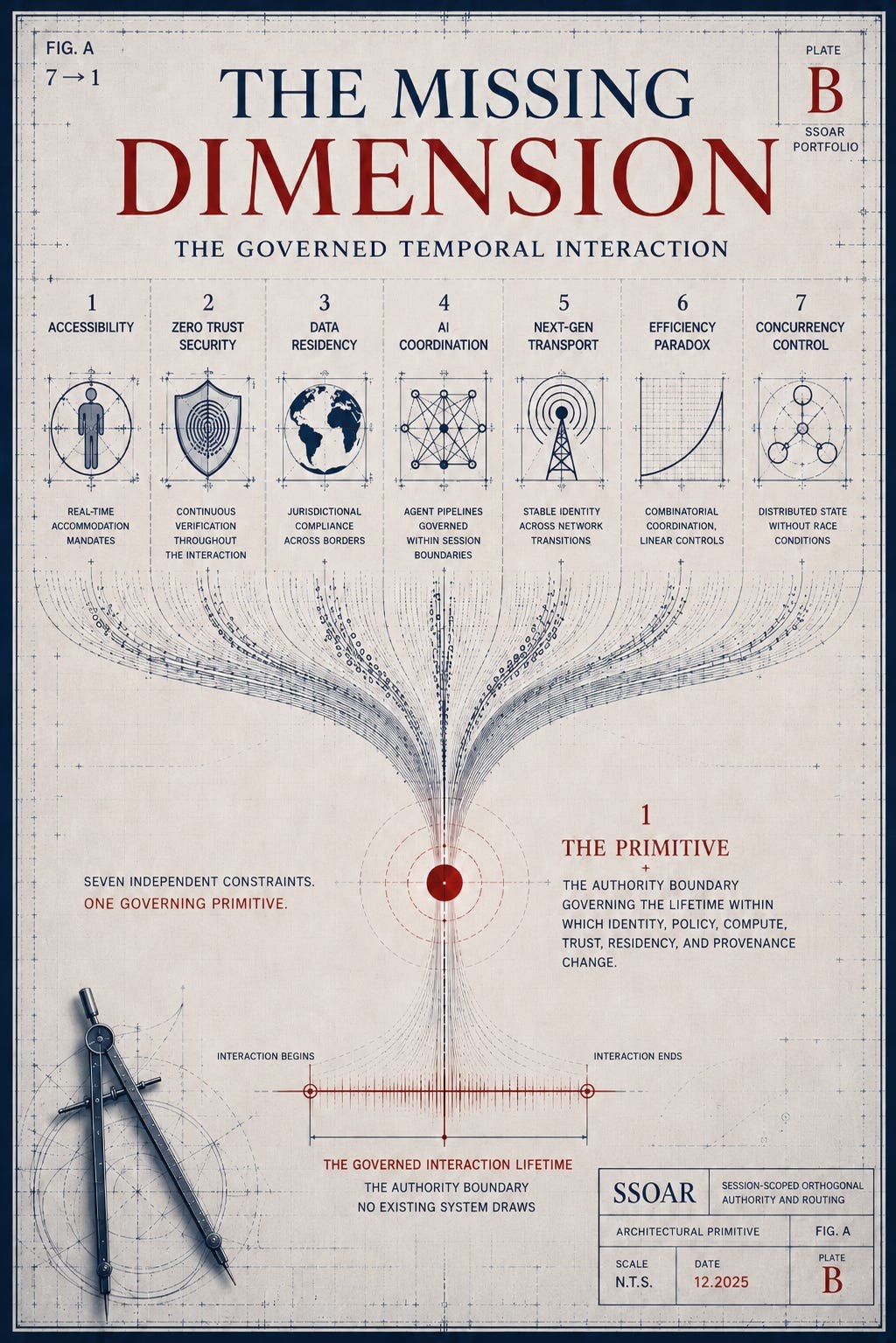
Start with the strange part.
The field is not disagreeing with SSOAR. Across a dozen domains, working independently, serious people are specifying exactly the requirements the constraint implies. Runtime admissibility. Provenance. Bounded delegation. Continuity across change. Accessibility proved during the interaction rather than attested after it. Sovereignty over where state moves. Zero Trust enforced before the transition rather than reconstructed after it. Governable capability after deployment, not only before.
Every one of those is a piece of the same thing. None of the parties specifying them has named the thing. That is the puzzle. The market is not rejecting the primitive. It is converging on the primitive’s requirements without recognizing the primitive they are converging on.
A companion essay, Before the Market Names the Primitive, argued that the constraint was first named and issued, and that the market is now arriving on schedule. This essay answers the question that is raised. If the requirements are specified everywhere, why does the convergence still look like a dozen unrelated problems rather than one?
The answer is not that the engineering is weak. The answer is that the field is decomposing the problem along the wrong axis for this particular abstraction.
The title will be misleading if read too quickly, so let me close that door first.
The missing dimension is not time in the sense the word usually carries. Not timestamps. Not clocks. Not ordering, scheduling, or vector clocks. Engineers reason about all of those fluently, and have for decades. If the missing piece were temporal in that sense, it would have been found long ago, because the tools to find it are everywhere.
Not the Clock
The missing dimension is the interaction itself, understood as a governed interval rather than a sequence of events. It is not a measurement of time. It is a thing that exists in time, has a boundary, and holds authority for its whole duration. The precise phrase is the governed temporal interaction. Hold that phrase. The rest of the essay is about why it is so easy to walk past.
There are two ways to decompose a system, and they surface two different kinds of things.
The first is functional. You cut the system into what it does. Identity. Transport. Authorization. Storage. Orchestration. Provenance. Accessibility. Payment. This is the decomposition every competent engineer is trained in, and for good reason: it is how you build maintainable systems, assign ownership, and reason about failure. It is correct. It is not the problem.
The second is to ask a different question entirely. Not what the system does, but what is the object that all of those functions are acting on? Sometimes there is no such object worth naming, and functional decomposition is the whole story. Sometimes there is, and until you name it, every function looks like it stands alone.
The market is decomposing functionally. It asks:
How do we govern agents?
How do we govern tools?
How do we govern memory?
How do we govern payment?
How do we govern accessibility?
How do we govern provenance?
Two Ways to Cut the Same Problem
Each question is legitimate. Each produces a real answer. And each answer is a control placed around a component.
SSOAR asks a question one level earlier:
What governs the lifetime within which all of those things change?
That is not a harder question. It is a different one, and it is invisible to functional decomposition because the thing it names is not a function. It is the interval within which the functions run.
Here is the whole diagnosis in one line.
The market is converging on the controls without converging on the object those controls are meant to govern.
That is what the field evidence shows when you read it as a body rather than as a list. Runtime admissibility is a control. Provenance is a control. Bounded delegation, accessibility, sovereignty, continuity: all controls. Each of them is specified with care. Almost none of them are being attached to the live interaction as the thing that owns them. They are attached to components. Placed before the interaction, or after it, or around it. Never bound to it.
This is why the solutions look like bolt-ons. Not because the people building them are careless. Because they have nowhere to integrate. A control needs an object to govern. If the object has no name, each control is fastened to the nearest component instead, resulting in a system that is locally correct everywhere and globally unaccountable. The bolt-on is not a symptom of poor engineering. It is what good engineering does when the governing object is missing. You solve the instance in front of you correctly, and you move on, because there is no larger object to solve it into.
The Sentence
A Method Succeeding, Not an Intelligence Failing
It would be easy and wrong to read this as a claim that the field is not clever enough to see it. That is not the claim, and the record does not support it.
Functional decomposition is not a mistake. It is the success of a method. And it is precisely that success that keeps the object hidden, because the object is not a function, and a method that decomposes by function will never produce a thing that is not a function. The tool is working exactly as designed. The thing it cannot return is a thing outside its output space.
You can watch this happen without any loss of talent involved. Consider an engineer working on a real-time system from the inside. The progression is natural: a token, then an agent, then a room where participants meet, then authority over that room, then a mandate that scopes the authority, then approval structures over the mandate. Every step is an improvement. Every step is correct. At no point does the engineer make an error. And at no point does the progression turn to ask what the room actually is, because the room keeps functioning as infrastructure, as a place where things happen, rather than as the governed object that persists while everything inside it changes. Nothing is missing from the work. The decomposition simply starts one level later than the object lives, so the object never enters the frame.
That is the honest shape of the recognition problem. It is not that people are failing to see something obvious. It is that the correct method, applied well, looks past the one thing this abstraction requires you to name.
There is a reason this particular object hides better than most.
You cannot easily see a container you are standing inside. Functional decomposition examines the elements of the interaction: the participants, streams, calls, and mutations. The interval is not one of the
Why the Interval Is the Hardest Thing to See
things. It is the boundary within which all of them occur. It has no packets of its own. It does not appear in a trace. It is the one part of the system that is present at every moment and visible at none, because it is the frame and not the content.
That is what makes the governed temporal interaction the last thing found rather than the first. Everything happening inside it is easier to point at than the inside itself. The interval only becomes visible when you stop asking what is happening and ask what all of it is happening within. Most work never has a reason to ask that, because at human-in- the-loop scale, the interval is held together by a person, quietly, at every seam, and an object that is being held together for free does not announce that it exists.
There is one more piece of evidence, and it is a matter of record rather than argument.
The Hermes-Echo portfolio was not assembled by gathering ten unrelated capabilities under a brand. It has an order. First, an embodiment that governs mutation inside a live session without originating a second authority. Then an embodiment that governs the state before admission, in which a participant sits within a bounded space but is not yet in the main interaction. Then an embodiment that makes participation itself negotiated, so that accommodation is part of the interaction rather than fastened beside it. Those three, taken together, are the object becoming visible. Once it was visible, the remaining questions stopped being “What else should we invent?” and became “What must be governed if this object truly exists?” The remaining filings are the answers: how authority moves under it, how compute is placed under it, how residency is decided under it, how trust is verified under it, how provenance binds to it.
To name them: Hermes-Echo, Warten, and Ludwig’s Raven form the temporal space; the siblings govern what changes inside it; and
The Sequence as Evidence
together the ten tame concurrency within a boundary no single layer draws.
Read forward; that looks like ten inventions. Read backward from the object, it looks like one object and the governance it implies. The sequence is not offered here as a biography. It is offered as evidence that the object is real because once it became visible, the rest did not have to be invented so much as filled in. Things that fill themselves in around an abstraction are the signature of a primitive. Things that must each be invented separately are the signature of features. This filled itself in.
Every mature engineering discipline eventually discovers that some abstraction had been missing the whole time, sitting beneath work that had been proceeding without it.
Sometimes the missing abstraction is a packet.
Sometimes it is a name.
Sometimes it is a route.
This time it may be the governed lifetime of the interaction itself: the interval in which agents act, tools fire, memory changes, payments settle, jurisdictions cross, and authority either survives the crossing or is minted fresh and reconstructed after the fact.
The market is not at odds with that abstraction. It is specifying its requirements, control by control, in a dozen vocabularies at once. What it has not yet done is name the object those controls are meant to govern. When it does, the convergence that currently looks like a dozen separate problems will resolve into one, and the resolution will feel, as these things always do afterward, obvious.
Closing
The object was there the whole time. It is the one part of the system that functional decomposition was never designed to return.
The formal vocabulary is maintained in the Hermes-Echo glossary, archived at zenodo.org/records/20355817. Public education regarding SSOAR, Hermes- Echo, Warten, or related architectures does not grant or imply any license, implementation right, covenant not to sue, waiver, or authorization. Any commercial, technical, or operational use requires a separate written agreement with Let’s Roll Marketing LLC. All rights reserved.
Continue to the architecture reference companion: Use one concrete state change to identify the undertaking, its governing conditions, the decision and the resulting evidence. Then connect the finding to the family functions and public record.