Originally published on Thomas’s Substack. Reproduced from the supplied publication export. Statements and patent-status references reflect the original publication date.
Editorial introduction · added September 17, 2026
Before you read
Capability does not confer the right to use it. Drawing on governed roles in physical systems, this essay argues that AI should be treated as a participant with bounded, revocable permissions. SSOAR provides the proposed interaction-level authority outside that participant. The point is to make powerful capability governable without treating the model as the source of its own mandate.
SSOAR means Session-Scoped Orthogonal Authority and Routing.
Why read it?
- Business and policy leaders
- Reframe AI control in terms of roles, permissions, and accountability.
- Platform architects
- Locate authority outside the participant while preserving useful independent action.
This introduction is separate from the original essay.
Go to the original essay ↓The scariest thing about AI discourse is not that people think AI is powerful. It is that even many of the people building it talk as if it is unbounded.
Listen to how the conversation moves. AI is described as a force in the world: deciding, escaping, replacing, wanting, optimizing, and taking over. Capability slides into agency, agency slides into authority, authority slides into sovereignty. By the end of the paragraph, the model is a thing that acts upon the world rather than a thing that participates in a structured interaction. The mythology accumulates without anyone defending it.
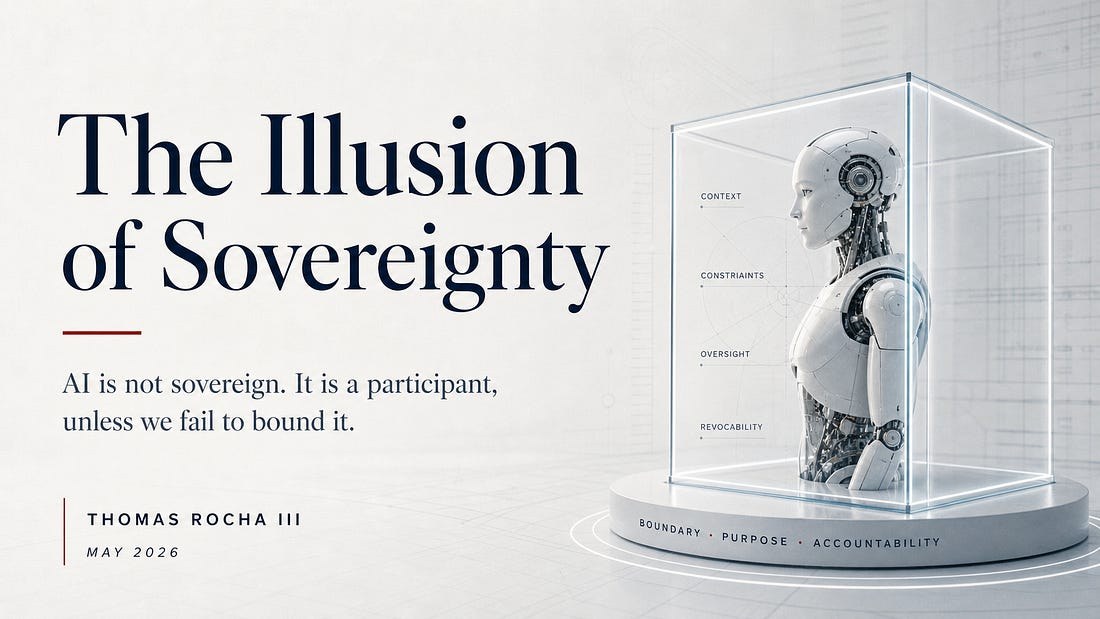
That language is doing damage. It turns a systems problem into a theology problem. And it makes the actual remedy sound small.
One distinction has to be made early. Unbounded does not mean limitless. It means no enforced limit. The limits are possible. They are simply not present. The mythological framing trades on the slippage between the two, because limitless is something to fear, and unbounded is” is something to fix. Most of the AI conversation is operating in the first register, while the problem lives in the second.
Capability is not authority.
A surgeon may know how to perform an amputation. The surgeon’s authority to perform the amputation is bounded by credentialing, scope of practice, surgical checklists, and a license that can be revoked. The capability is not diminished. The authority is structured.
The same shape repeats in every domain where capability has consequence.
The railway switch person controls a corridor of high-speed track. A wrong block assignment kills people at scale. The role exists invisibly to most travelers, but it is the layer that decides which train enters which section of track at which moment. The switch person’s authority is scoped to specific blocks during specific intervals. The authority can be revoked, reassigned, or suspended.
The air traffic controller occupies the cleanest version of this structure. A flight is cleared for approach. The phrase is not metaphor. It is a session-scoped, interaction-bound, revocable authority statement. The controller is not granting the aircraft sovereignty. They are admitting it to a specific block of airspace for a specific maneuver. The clearance can be withdrawn at any moment, and the aircraft does not lose its capability when the clearance ends. It loses its admission.
The grid operator coordinates a region. Generators, transmission, demand response, ISO directives, frequency stability. The blast radius is the largest of the three. The operator works inside continuous authority constraints that travel with the interaction. The grid is not autonomous. It is not unbounded. It is enormous, semi-autonomous in many of its parts, and held in coordination by an authority structure that no single participant in the system controls.
In every one of these roles, the operator’s capability is enormous and the operator’s authority is bounded. The bounding does not weaken the capability. It is what makes the capability deployable at all.
AI should be read into the same shape.
The public debate keeps asking the wrong questions.
Can the model be aligned? Can the model refuse? Can the model explain itself? Can the model be made safe? These questions are not unimportant. They are insufficient, because they all locate the boundary inside the model.
A boundary inside the thing being governed is not a boundary. It is an aspiration the thing carries about itself. Aspirations fail under pressure. The aspiration does not need to fail in malice or in error. It only needs to fail in ambiguity, and ambiguity is the operating environment of any agent that touches a real system.
The boundary has to live somewhere the model cannot reach. Outside its reasoning loop. Outside its memory surface. Outside its tool surface. Adjacent to the interaction, evaluating each move against a scope the model is not authoring.
This is what AI safety has not yet built, and it is what every credible analogue from physical systems already has.
The constructive frame is already in the language used everywhere else.
AI should be one participant inside a live interaction. The participant may have permission to read context, generate outputs, propose actions, call tools, mutate state, or retain memory. Each permission is scoped to the interaction. None carries forward by default. None survives a change of session by accident. None creates authority merely because the participant discovered a path through the system.
This is not a leash. It is a role. The same role every other powerful actor occupies in every other governed environment.
A previous essay argued that current agents are unsupervised rather than autonomous. This one argues that the deeper mistake is treating them as sovereign rather than as participants. The two illusions reinforce each other. An agent imagined as autonomous and unbounded is mythological. An agent operated as a participant inside a governed interaction is a working component of a system that can be tested, audited, stopped, denied a state transition, and made to operate under policy.
The psychological consequence follows from the architecture, not the other way around.
People fear AI because they imagine it as agency without walls. The imagination is not irrational. It is a correct response to an actual missing structure. The fear cannot be argued away by reassurance from the same institutions that deployed architectures without the missing boundary. It can only be retired by building the structure that was missing.
A bounded participant can be tested. A bounded participant can be audited. A bounded participant can be stopped. A bounded participant can be denied a state transition. A bounded participant can be made to operate under policy.
An unbounded actor can only be feared, worshiped, or appeased.
The industry keeps asking whether AI will become autonomous. It is the wrong question. The question is whether AI will continue to be deployed as unbounded capability, or whether it will be placed where every other powerful actor belongs: inside a governed interaction, with authority outside itself.
AI does not need to be mystified to be taken seriously.
It needs to be bounded.
Continue to the ai authority architecture companion: Use a bounded invoice task to inspect an agent’s permissions. Test changes to the object, operation, approval, delegate and timing, then verify which component controls the result.