Originally published on Thomas’s Substack. Reproduced from the supplied publication export. Statements and patent-status references reflect the original publication date.
Editorial introduction · added September 17, 2026
Before you read
A reliable control link does not establish who may authorize the next consequential action. This essay uses remotely operated and autonomous systems to distinguish connectivity from continuing authority through handoffs and changing conditions. Its SSOAR connection is the governing boundary around the undertaking. Maintaining that boundary also requires explicit limits on what can be known or revoked when communication is unavailable.
SSOAR means Session-Scoped Orthogonal Authority and Routing.
Why read it?
- Critical-systems architects
- Separate transport reliability, local controls, and continuing authorization in a system review.
- Public-sector technology buyers
- Ask how scope and accountability survive handoffs between independently controlled systems.
This introduction is separate from the original essay.
Go to the original essay ↓Dan Driscoll submitted his resignation as Secretary of the Army on August 31. Whatever gets written about his eighteen months, one
obsession was unmistakable. The man Trump reportedly called the “drone guy” wanted the Army to learn from Ukraine, to connect systems that could not talk to each other, and to operate unmanned systems at scale.
He was right about all three. What none of them settle is the problem underneath.
Start with perhaps the strangest weapon on the battlefield.
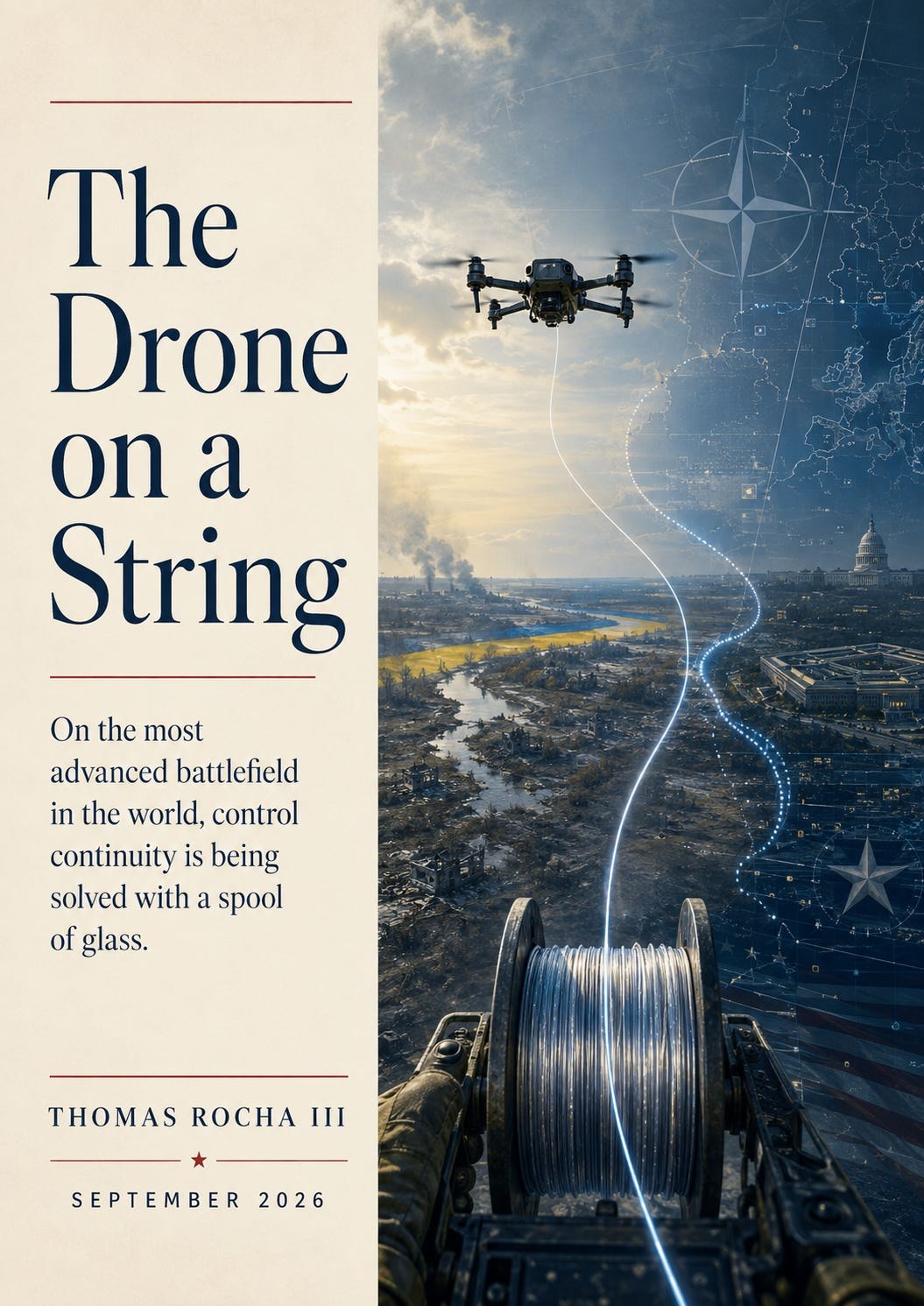
A first-person-view quadcopter, cheap and fast, trailing a hair-thin fiber- optic cable that unspools behind it as it flies. Five to twenty kilometers of glass, lying across the forests and rooftops of eastern Ukraine.
NATO’s Allied Command Transformation dates the first documented deployments to Russian units in late 2024, initially around Kursk, then across Donetsk and Zaporizhzhia. Both sides field them now. In April 2025, NATO’s Innovation Hub and its Joint Analysis, Training and Education Centre opened a formal Innovation Challenge to find a way to defeat them. The solicitation is blunt about why: “EW counter-UAS systems are ineffective against this type of drone.” The challenge drew a record 162 submissions, including 42 from Ukrainian teams.
The control link cannot be defeated by conventional jamming because it is not radio. There is no command channel to overpower or spoof. The fiber also carries high-bandwidth, low-latency video, without depending on a contested electromagnetic spectrum, which matters most at the moment of terminal guidance.
Engineers expected the cable to snag in trees and to cost too much range to be worth it. It doesn’t, and it isn’t. The wire pays off, and everyone on both sides of the line now knows it.
A drone on a wire
What the cable actually solves
Radio is mutable, and the mutation is the problem.
Jamming works. Spoofing works. The electromagnetic environment changes minute to minute. A link that exists is a link that can be taken away, and when it goes the operator loses live control of the aircraft. What the aircraft does next depends on whatever behavior was already placed onboard.
The fiber removes that class of failure. So long as the cable remains intact, the control path no longer depends on a radio link the electromagnetic environment can jam or spoof.
That is a real solution, arrived at by people solving a lethal problem with what they had. Nobody should be condescending about it. It is cheap, it works, and it is winning engagements.
It also has an edge, and the edge is a boundary.
The spool has a length. Five kilometers, or twenty, or thirty in newer systems. Whatever the number, the architecture has purchased continuity by drawing a physical boundary around it.
Cross that boundary and the property disappears. Extend the mission past it and some other mechanism has to carry control.
That is what makes the tether architecturally interesting. It does not generalize continuity. It bounds it.
Range, weight, and topology are the price of preserving a relationship the digital environment cannot itself guarantee.
So be precise about what the cable solves.
The cable does not carry authority. It carries control.
The distinction matters. Fiber answers a brutally practical battlefield question: can the operator still reach the aircraft after the electromagnetic environment changes? It does not answer the next one: after everything else has changed, is what the aircraft is about to do still authorized under the undertaking that put it there?
That is why the tether is worth staring at. Once the control path becomes unusually reliable, the next problem gets easier to see.
Something still has to answer that question.
Today, a person does.
One pilot, one aircraft, one wire. The operator does not originate the mission authority. That arrives through the command structure. But at the edge, the operator carries it: what the aircraft was tasked to do, what constraints govern that task, and whether changed conditions still fit the authority that put the aircraft there.
And the fiber is not incidental to that judgment. It is what makes it possible.
Consider a manually controlled strike. The fiber can keep high-quality sensor imagery in front of the operator until the final moments. If what the operator sees no longer satisfies the mission constraints, the human can withhold or abort, where the platform and circumstances permit it.
That is authorization evaluated at the moment of the act. Not planned in advance and hoped for. Not reconciled afterward from a log. Evaluated against the governing authority at the instant the state is about to change, with the power to refuse.
Three things make it work. The fiber keeps the observation path intact. The human is the decision point. The ability to withhold is the fail-
The human at the end of the wire
closed behavior.
That is the oldest method there is. Put a person at every consequential crossing and make them responsible for what the machine does. It works, it has always worked, and it requires no architecture at all, because the human is the architecture.
The physical solution also scales badly. Each aircraft still needs its own control path, and the judgment sitting behind that path does not automatically scale with it.
Autonomy breaks the human ratio. So do swarms, and so does machine-to-machine tasking. The moment one operator becomes responsible for many machines, or no operator is present at the instant of action, the carrier is gone.
Notice what goes with them. The effector still acts. The observation path may still exist. What disappears is the human decision point at the consequential transition.
A machine may still contain constraints capable of refusing the act. The architectural question is whether those constraints remain expressions of the same governing mission authority, or are simply local rules loaded earlier into the machine.
So the problem is not that autonomy eliminates every possible check. It is that the governing relationship has to survive the transfer of that check from a human, across a communications break, into an autonomous effector.
Absent that, the check moves in one of two directions, and neither is where the consequence happens. It moves earlier, into planning, which is mission-binding at plan time. Or it moves later, into the record, which is accounting. The one place it no longer sits is the instant before the act becomes authoritative.
That is the principle the whole problem turns on. Evaluation has to occur at the consequential transition, before the act becomes authoritative, at a decision point capable of refusing it. Otherwise it is not governance of the transition. It is accounting for one.
And it is not as though nothing has been written down. Militaries encode authority constantly: rules of engagement, commander’s intent, air tasking orders, positive identification criteria, national caveats, weapons release authority. Some of it is already machine-enforced: geofences, no-fire areas, weapons interlocks, route and target restrictions.
So the gap is not a blank page, and it is not an absence of machine enforcement. What I have not found is a common authority object that carries the governing relationship among those constraints across changing machines, networks, operators, and decision points for the duration of the undertaking.
Ukraine did not fail to try. It has worked this problem longer, harder, and under worse conditions than anyone.
Aerorozvidka formed in May 2014, a volunteer group of drone and software people, in the weeks after Russia took Crimea and moved into the Donbas. NATO stood up a C4 Trust Fund the same year to help Ukraine with command, control, communications, and computing. Development of DELTA began in 2015. It was first tested in 2017 under a NATO initiative, passed interoperability checks at NATO’s TIDE Sprint in 2022, became broadly operational during that year’s fighting, and in February 2023 the Ukrainian government formally authorized its introduction throughout the Defense Forces.
Senior figures who led its development told Armada that Ukraine had no automated operational-level command and control system in 2014, and that the intent was to build a “sensor-agnostic command and control system” capable of taking inputs from disparate sources.
DELTA is the proof, not the failure
That is a precise description, from the people who built it, of the problem they set out to attack in 2015.
What they built is extraordinary. According to Ukraine’s Ministry of Defense, troops logged more than 200,000 strikes in DELTA in June 2026 alone, an average above 6,600 a day, with the monthly total nearly doubling since January. The ministry reports more than 8 million new objects added to the digital map each month, 820,000 engagement reports over the preceding year, and more than 75,000 video streams daily, with an AI platform called Avengers performing automatic detection in battlefield feeds.
Mission Control has been evolving inside DELTA for years. It opened to all DELTA users in January 2025, having already been used by more than 300 units running roughly 900 missions a day and over 200,000 in total, with responsibility zones, route planning, and real-time task coordination. A year later, Defense Minister Mykhailo Fedorov ordered a far broader standardized implementation, turning it into the unified digital command-and-control and reporting system for drone operations across the force. That version requires crews to enter drone type, launch point, route, and mission, and it retired paper reporting. By early March 2026, more than 150,000 digital mission reports had been generated. Fedorov describes the objective as a system in which “every action is transformed into data, and data into decisions.”
At NATO’s CWIX exercises, DELTA has exchanged operational data with allied systems, including integration with Poland’s TOPAZ artillery fire control system.
That is a decade of continuous work, under national survival stakes, with allied funding, by engineers operating without procurement drag and iterating weekly against a live adversary. There is no better- motivated software organization on earth.
What it produced is one of the most sophisticated battlefield situational-awareness and integration systems ever fielded.
And DELTA is closer to the line than a phrase like situational awareness suggests. Recording task and route for every flight is mission-binding at plan time and at log time. That is real, and it is further than most militaries have gotten.
It is also moving toward the edge. Ukraine’s Ministry of Defense describes models trained on its Avengers dataset supporting two now- common scenarios: an operator marks a target, and the drone autonomously corrects its trajectory in the final stage, and an unmanned system enters a designated area, detects a target on its own, and acts according to the mission logic. More than seventy AI and computer-vision systems are already helping Ukrainian forces strike targets. Machine enforcement of mission logic is not hypothetical.
So the claim worth making is narrower than saying DELTA cannot constrain a machine.
Look at what Ukraine says about the human decision, because they are careful about it. The Ministry of Defense states that a human operator makes the final decision on target selection and engagement, even as it pushes to equip every frontline drone with computer vision.
Now look at what the same ministry says happens next. In one common scenario it describes, the operator acquires the target, and the drone then takes over terminal correction. And once a target is captured, the system can continue moving autonomously even if the operator loses contact through Russian electronic warfare.
Hold those together, because between them is the entire problem.
The line DELTA reaches
A human decision occurs. A delegation follows. The link then drops, by design and by the adversary’s intent, and the machine continues toward the target.
What disappears for certain is the external revocation path. Nobody reachable can narrow, withdraw, or countermand while the act completes.
It does not establish that authority disappeared. Ukraine could reasonably say the operator authorized this target, delegated terminal execution, and that the authorization survives the loss of communications. There may well be onboard geofences, target classifiers, or mission constraints that are not publicly described.
So the honest question is the sharper one. Is the machine executing an earlier authorization, or does each consequential transition remain conditioned on the same surviving mission authority as circumstances change? What carries that authority forward inside the machine, and what is still able to say no?
That is not a failure of Ukrainian engineering. It is a deliberate and reasonable trade: EW resilience purchased at the cost of external revocability. The fiber preserves that path and pays in range. Autonomous terminal guidance keeps the range and pays with the path.
Both are working around the same requirement, and it is worth stating plainly.
The governing authority has to survive even when the communications path does not.
So the next question is not whether a machine can be constrained. Ukraine has shown it can. It is under what continuing authority the next consequential act is permitted to become authoritative, and whether anything evaluates that at the moment it happens.
And it is not a criticism of DELTA that it stops there. What I have not found in the public architecture is the next layer: a single governing mission object whose authority remains controlling as the operation mutates, against which each consequential transition is evaluated before the effector commits it. What makes DELTA so useful as a case study is how far an extraordinarily sophisticated system can come before that distinction becomes visible at all.
Which brings back the Secretary who just resigned.
Driscoll has been explicit about where his thinking turned. The catalyst, he told reporters, was Germany. He was visiting allied training sites with General Christopher Donahue when Ukrainians showed him DELTA, and by his own account, a light bulb went off: everything he had seen in the previous fifteen or sixteen months was less integrated, less simple, and less effective for the warfighter.
The result was Operation Jailbreak. In May 2026 at Fort Carson, the Army ran the first sprint of its Right to Integrate initiative, bringing in roughly 600 engineers from more than 50 industry partners to open the interfaces of over 70 military capabilities and force sensors, platforms, weapons, and command systems so they could exchange data in real time. Software from the hackathon was pushed to Central Command within 30 days.
So the chain runs: DELTA, then Germany, then Jailbreak, then everything connects.
Now read the stated purpose of the effort. The Army described it as intended to “reduce reliance on soldiers as manual system integrators during operations.”
That is the Army saying, in its own words, that soldiers have been the integration layer, and that the goal is to stop needing them for it.
Driscoll saw the first half
They are right that it has to happen. No human holds the picture at drone-swarm tempo, and using people as connective tissue is why American systems could not talk to each other in the first place.
But notice what that commits to. The person who carried context between systems, who knew whose mission this was, who recognized when a technically available action was not authorized by the circumstances, is being removed from the middle of the loop on purpose.
The seams remain. The carrier is leaving.
Integration without an authority object does not close the seam. It moves it. The old problem was that systems could not talk. The new one is that making them talk does not establish which utterance still counts under the authority governing the operation.
Driscoll matters for another reason right now.
He is leaving while the institution argues about what lethality means, and the people who were building toward Ukraine’s answer are leaving with him. Randy George is gone. So is David Hodne, who ran Army Transformation and Training Command. So is Christopher Donahue, the general who was standing next to Driscoll in Germany, and who was moving fast to learn from the Ukrainians on drone warfare. CNN reported this week that sources inside the Army see those departures as a problem precisely because of what those officers were working on.
The public record does not establish that this is one coordinated reversal, and I am not going to claim it is.
What it does expose is a real choice. Lethality can be defined by making the individual warrior harder, which is an ancient and legitimate
Two ideas of lethality
project. Or it can be defined the way Ukraine has been forced to define it: how does one warrior govern a machine-speed battlefield?
Ukraine has fought Russia to a standstill, answering the second question. Not with better soldiers. With better architecture, built under fire, by people who had no alternative.
Driscoll read that correctly and moved. The right response is not to walk it back. It is to take the next architectural step, which Jailbreak sets up but does not finish.
The alliance is going further in the same direction, deliberately.
NATO’s Alliance Digital Strategy, published 13 January 2026, commits to embedding Zero Trust across all digital infrastructure with continuous verification and least-privilege access; to federated platforms for controlled sharing of data and computing resources; to cloud integrated with tactical edge computing; and to operating in degraded, contested, and denied environments. It also commits to accelerating post-quantum cryptography.
Read that as an architecture, not a list. Software-defined capabilities can change. Resources are dynamically orchestrated. Computing moves between cloud and tactical edge. Data crosses federated systems. AI enters the decision chain. Identity and access are continuously re- evaluated.
Mutation is not an accident in that design. It is the design.
And once mutation becomes a design objective, continuity can no longer be assumed from the components. Something above the components has to stay invariant.
NATO is making the infrastructure mutable on purpose
The scale is arriving on schedule. On 7 July 2026 in Ankara, Secretary General Mark Rutte launched NATO’s Drone Edge: more than forty billion dollars over five years for counter-drone capabilities, alongside a separate commitment to train five times as many drone operators by the end of 2027.
Once a radar, an AI system, a commander, an autonomous ground vehicle, a drone, and a weapon can all exchange state in real time, a question opens that interoperability does not close.
Which of them holds the authority to change the operation? On whose delegation? For how long? What happens when one disappears and returns over a different transport? What happens when an AI substitutes a different model or a different compute provider mid-mission? What happens when a machine with valid credentials proposes an action that no longer fits the mission it was committed to?
And underneath all of them: what survives every one of those changes and remains authoritative?
An API does not answer that. Neither does a certificate, a token, a mesh, or a perfect log assembled afterward. Those establish component truths. What is missing is interaction truth: whether one governing authority remained controlling while the operation changed shape.
Zero Trust as deployed verifies continuously at each control point, which is necessary and good. It confirms that this identity may perform this action on this resource now. It does not establish that the permitted act still belongs to the same governed undertaking after the undertaking has mutated.
That is a limit of the implementations, not of the idea. Mission attributes carried on the session, policy decision points at the tactical edge,
The question after everything connects
short-lived authorizations bound to a mission identifier, continuous re- authorization of actions rather than of access: none of that is forbidden by Zero Trust. It is simply unfinished.
Transport continuity is widely understood and increasingly well engineered. Authority continuity is still being carried, far too often, by the human at the other end of the fiber.
There is a cleaner way to say what is needed, and the battlefield already supplied the metaphor.
The primitive is not another security control around the mission. It is the object to which the security controls attach.
Not permanent connectivity. Permanent reference to governing authority.
A drone changes networks without changing the authority governing the mission. An AI system joins an operation without becoming its own authority. A replacement sensor contributes information without silently inheriting the privileges of the one it replaced. A commander narrows or revokes authority while the operation continues running. A machine that has drifted outside mission constraints stays visible on the network while losing the ability to produce consequential state.
None of that requires constructing a new independent trust domain every time something changes.
That is what session-scoped Zero Trust means in an operational context. Not trust this drone continuously, but continuously determine whether this drone’s proposed action remains admissible inside this mission.
A digital tether
The drone is replaceable. The sensor is replaceable. The model is replaceable. The network is replaceable. Even the operator is replaceable.
What cannot be replaced mid-operation without consequence answers one question: who, or what, still holds the authority to act?
Notice why the tether can answer a version of that question. It works because it creates the boundary it needs. A bounded zone, a person at the center, and inside it a control relationship that physics will not let the enemy break.
The Internet of Everything has no physical circle.
Billions of endpoints across operators, jurisdictions, networks, and providers nobody jointly controls. No center, no radius, no human standing at any particular seam.
But an operation always has a circle. A time window. An area of operations. An assigned task. A classification domain. A delegated commander. National caveats. The boundary is real. It simply is not made of glass.
That is the whole problem, and the whole opportunity. At this scale, the architecture has to make the logical boundary do what the physical one does.
One of the battlefield’s most resilient answers to contested control is still a physical tether whose boundary is measured in kilometers. Everything NATO is building now has to work without one.
The drone does not reveal that fiber is the future.
It reveals what the future still needs.
A boundary that survives mutation, and a decision point still capable of saying no when the consequential moment arrives.
The tether supplies both today, for one aircraft.
The next battlefield will need that in the mission object, at a scale no wire can reach, and no single operator can staff. Or it will keep putting a person back on the line and calling that an architecture.