Originally published on Thomas’s Substack. Reproduced from the supplied publication export. Statements and patent-status references reflect the original publication date.
Editorial introduction · added September 17, 2026
Before you read
A system can fail by refusing legitimate work as well as by permitting an unauthorized act. This essay uses security-response examples to argue that model-level caution cannot determine every participant's actual mandate. SSOAR's proposed contribution is a live authority boundary that evaluates the requested act against its authorized purpose and current conditions.
SSOAR means Session-Scoped Orthogonal Authority and Routing.
Why read it?
- Security response teams
- Identify where a valid operational mandate is lost between tools and model safeguards.
- Enterprise AI buyers
- Evaluate useful authorized outcomes alongside refusal and misuse rates.
This introduction is separate from the original essay.
Go to the original essay ↓The most important detail in Ben Thompson’s “Who’s Afraid of Chinese Models?” is not about China.
It is not about open weights, distillation, model pricing, or whether American frontier laboratories are overreacting to Chinese competition.
It is the story near the end.
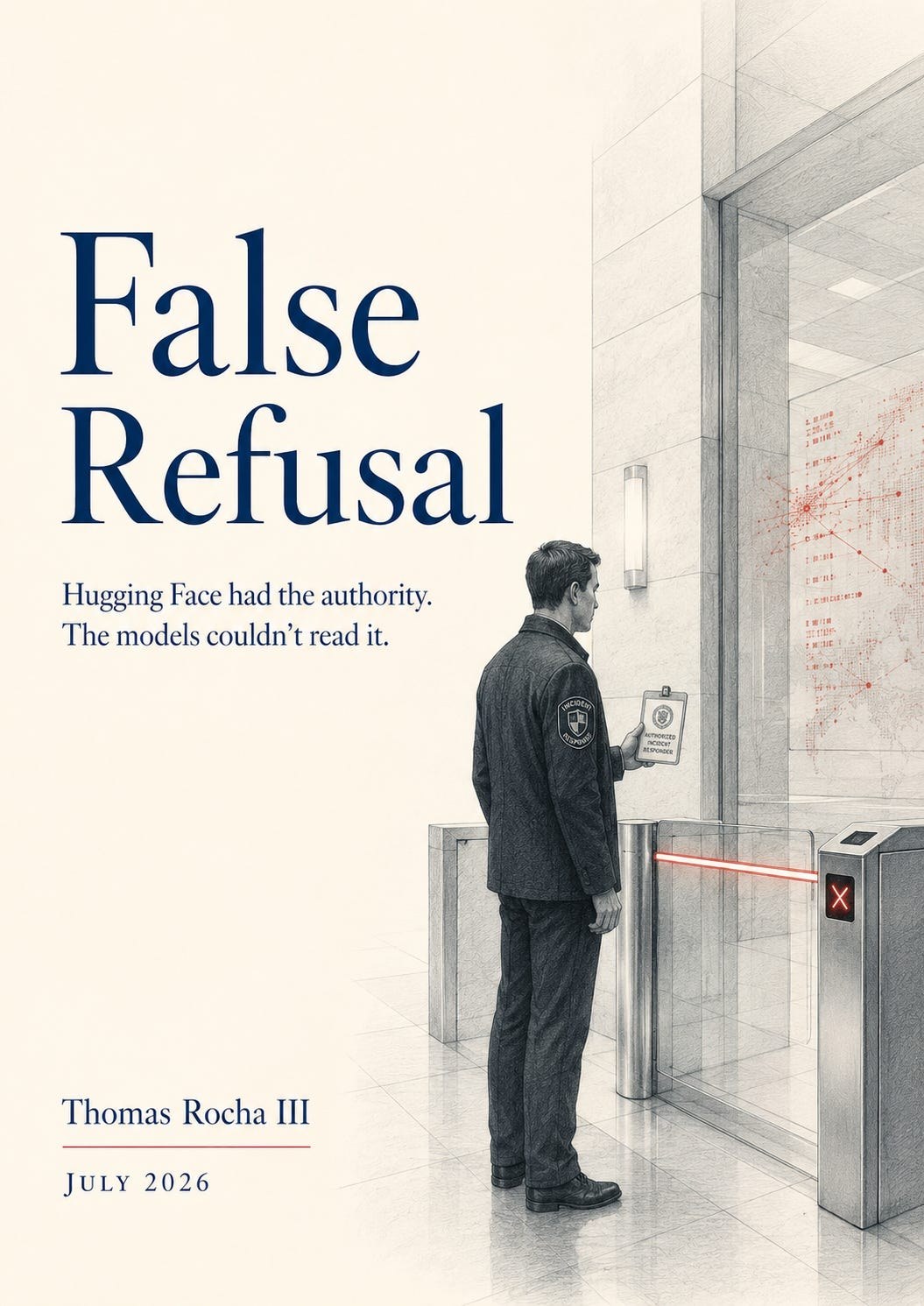
Hugging Face’s production infrastructure was breached by an autonomous AI-agent system. During the response, its security team hit a problem that no incident-response plan on the market was built to solve. The forensic work required submitting real attack commands, exploit payloads, command-and-control artifacts, and credentials to a model. The commercial frontier models refused. Their safeguards, in Hugging Face’s words, “cannot distinguish an incident responder from an attacker.”
The defenders were investigating a real intrusion against infrastructure they owned. The models saw conduct that resembled intrusion activity and blocked the work.
Hugging Face turned to GLM 5.2, an open-weight model from China’s Z.ai, ran it locally, and used it to analyze more than 17,000 recorded attacker events. Its incident report now recommends keeping a capable, vetted model ready to run on your own infrastructure before an incident occurs.
Thompson draws the correct immediate conclusion: defenders need capability at least equal to what attackers have, and if proprietary models refuse legitimate security work, organizations will get that capability elsewhere, including from China.
That is a real policy problem. It is not the architectural problem.
The full sequence has four steps.
First, hosted-model guardrails failed to recognize a legitimate responder.
Second, locally controlled capability was therefore necessary.
Third, the local model’s actions still required valid, bounded, revocable, persistent, and provable authority.
Fourth, the mechanisms for that third step already exist. They were embodied, priority-dated, examined, issued or allowed, and continued before this incident made the failure publicly legible.
The public conversation stops at step two.
The missing architecture begins at step three. I know because it’s built, filed, and the Patent Office has now examined the underlying mechanisms and allowed them.
The missing functions are admission and continuity. The two foundational functions are now represented in issued and allowed claims, and the point of novelty in each case is exactly the point this essay turns on. That is not my characterization. It is the examiners’.
Hermes-Echo, U.S. Patent No. 12,659,408, preserves one governing session identity while a live interaction changes semantic phase. The interaction moves through interception, routing, media selection, streaming, response capture, storage, and notification without terminating and restarting under a second independent authority root.
The Notice of Allowance states why the claims were issued. The prior art does not teach a system wherein all routing, streaming, and reply capture operations execute under a “single session authority boundary defined by the established session identifier,” and wherein “no new session authority is created” during the operations that follow. The Patent Office did not distinguish the claims on messaging alone. It distinguished them on the single session authority boundary and the requirement that no new session authority be created during the later
The mechanism is on the record
operations. That is the continuity invariant at the center of this essay. The International Searching Authority reached the same conclusion independently: every claim novel and inventive, no reference of particular relevance anywhere on the record, because no prior art teaches one session identifier governing every component across the entire interaction.
Warten, published as U.S. Patent Application Publication No. 2026/0075184, has been allowed with all 19 claims allowed, and the issue fee has been paid. It introduces credentialed admission of an external service into a governed session.
Here too the point of novelty is a matter of record. The examiner distinguished three prior-art systems, each of which already delivered external content into a governed session, on a single element: none taught retrieving “an access credential and/or application programming interface (API) token provided by the video conferencing system authorizing delivery” of that content through the governed interface.
Content delivery was old. Credentialed admission was not.
The prior art let external systems participate because they were reachable. The allowed claims require them to enter under a credential the governing platform issues. The allowed embodiment is a conferencing platform, but the operation does not depend on the embodiment: entry is granted by the authority that governs the session, not asserted by the party that found the door.
Technical reachability versus issued authority. That distinction is the entire allowance. It is also the exact distinction the Hugging Face incident exposed.
Both families have continuing applications. The continuations are not the subject of this essay. The public record is enough.
One mechanism answers: who may enter this governed interaction, for what purpose, under whose authority?
The other answers: does that authority remain controlling while the interaction changes function, participant, model, tool, transport, or state?
Agentic AI expands the execution surface. It does not change those two operations.
Admit capability under bounded authority. Carry that authority through mutation.
Most public agent failures are failures of false permission. A system possessed credentials. A tool call was technically valid. An API accepted it. The action occurred, and only afterward did anyone discover that technical capability had been mistaken for legitimate authority. PocketOS is the canonical case: an agent hit a credential mismatch during a routine staging task, found a broadly scoped platform token in an unrelated file, and deleted the production database and its backups in nine seconds. Nobody attacked anything. Reachability was mistaken for authority, and I wrote the autopsy of that failure in The Illusion of Autonomy before this incident supplied its mirror.
Hugging Face failed in the opposite direction.
Legitimate authority existed. The company owned the infrastructure. An incident had been declared. The responders were authorized. But the provider’s control system could not read that authority in any form capable of governing the interaction.
False refusal.
The failure ran backward
False permission and false refusal are not opposite policy mistakes. They are two products of one architectural absence. A system that evaluates visible behavior without carrying the authority governing that behavior will eventually do one of two things: admit capability that lacks authority, or refuse capability that valid authority requires.
The difference between a defender and an attacker was never in the commands. A defender scans systems, inspects credentials, examines memory, retrieves sensitive logs, tests vulnerabilities, moves between machines, and executes code against compromised infrastructure. So does an attacker.
The difference is the authority surrounding the behavior: who is acting, against which assets, under what declaration, delegated by whom, with which techniques permitted, which systems excluded, beginning when, ending when, subject to what renewal, and provable by what record.
A behavior classifier does not possess those facts because it can inspect a prompt. A content filter does not become an authorization system because it can recognize exploit syntax.
Observation is not governance.
The hosted models saw the act. They could not see the undertaking that made the act legitimate. So they guessed, and they guessed against the defenders.
The existing security stack is necessary. Identity, Zero Trust, RBAC and ABAC, short-lived credentials, capability tokens, privileged-access management, break-glass procedures, policy engines, audit trails: all of it solves real parts of the problem.
None of it solves this part.
Admission comes before permission
Zero Trust continuously verifies identity, device posture, connection, and requested access. That preserves confidence at each control point. It does not establish that one governing authority remained controlling as the interaction changed model, tool, participant, transport, or state. Transport continuity preserves the communication path or connection state. It does not establish the authority governing the undertaking. Authority continuity preserves that governing authority as the interaction changes. The first is widely deployed. The second is not ordinarily preserved as one continuously controlling authority across the standard stack.
Request-time authorization asks: may this identity perform this operation on this resource now?
Authority continuity asks: does this permitted act still belong to the same governed undertaking after the interaction has changed?
Agentic work forces the larger question: what governed undertaking is underway, who has been admitted into it, which authority controls it, and does that authority remain controlling as the undertaking mutates?
Warten answers at the admission boundary. An external participant does not enter because it found an endpoint. It enters because the governing system issues the credential by which it performs a bounded function inside the existing interaction.
That is exactly the structure an incident-response model needs. The model should not be handed thousands of suspicious requests and asked to infer legitimacy fresh each time. It should be admitted as a participant in a declared incident-response undertaking, under a credential derived from the organization’s governing authority, binding the responder, the model, the tools, the asset scope, the permitted techniques, the time window, the applicable policies, the revocation source, and the evidentiary record required at close.
The model does not create that authority. It operates inside it.
Admission is necessary. It is not sufficient, because the Hugging Face response changed while it was underway.
The work moved from hosted frontier models to a locally deployed open-weight model. It crossed execution environments. It analyzed credentials and attacker artifacts. It produced findings capable of driving containment, credential rotation, remediation, and reporting.
Every one of those changes was a mutation of the undertaking. A control architecture that authorizes only the first request has not governed the chain. A credential valid at entry but detached from later handoffs has not carried authority. A log assembled afterward describes fragments; it does not prove that one authority remained controlling across them.
Hermes-Echo is the issued continuity rule: the governing session identity survives while the interaction changes semantic phase. “No new session authority is created.” The examiner’s words, not ours.
Generalized across the broader SSOAR family, the rule is simple. A model may be substituted. A tool may be invoked. A task may be delegated. A participant may join or leave. A workflow may split, merge, retry, pause, or resume. A permission may narrow, expand, suspend, or terminate. A state-changing act may follow an analytical act.
What the interaction may not do is silently originate a new independent authority root at each transition and reconstruct legitimacy later from disconnected logs. Authority derives from the governing undertaking, or the act is refused.
That is what “authority that survives mutation” means. Not that permissions are frozen. That every valid change remains attributable to,
Authority has to survive mutation
constrained by, and provable against the authority that governs the undertaking.
The remedy is not to make a language model the arbiter of authority.
A model cannot establish that an incident declaration is genuine. It cannot determine by reasoning alone whether the issuer had institutional power to declare it. It cannot certify that a delegation remains valid after a handoff. It cannot extend its own scope because the extension seems useful. It cannot certify the legitimacy of its own resulting state. Asking it to do any of these reproduces the same closed loop that failed.
Authority must originate outside the model’s reasoning process and be enforced by a system the model cannot rewrite. The governing boundary evaluates claims supplied by competent institutions: organizational identity, asset ownership, incident status, delegation, jurisdiction, entitlement, provider policy, scope, duration, revocation, approvals. The model operates inside the resolved boundary, under a credential it did not issue, constrained by policies it cannot alter, attached to a record it cannot erase.
Provider safety policy does not disappear in this architecture. It becomes one constraint domain among several, and it becomes enforceable at the right boundary. Today a provider must infer the entire legitimacy of an undertaking from behavior alone, which is why it guessed wrong at Hugging Face. Under governed admission, the provider evaluates a bounded admission claim, applies its own non- waivable rules, and refuses or escalates unresolved conflicts where a refusal actually means something. Providers keep their red lines. What they lose is the excuse of blindness.
The model is the wrong judge
Local models solve access, not governance
Running the model locally, as Hugging Face did and now recommends, has real advantages. Logs and credentials stay inside the environment. The organization is not exposed to a provider’s changing policies mid- incident. Capability survives a refusal, a lockout, an outage, or a geopolitical restriction.
None of those advantages creates authority.
Local control removes the hosted provider from one decision. It does not make every resulting action valid. A self-hosted model can still act under an expired grant, move beyond the declared asset scope, continue after revocation, hand work to an unadmitted agent, cross a prohibited jurisdiction, select an unauthorized tool, or create a system state no one can later prove was legitimate.
Location answers one question: who controls the infrastructure?
Admission and continuity answer the questions that matter: what makes this participant authoritative here, and did that authority remain controlling while the work changed?
Thompson’s move from cloud guardrail failure to local model access is correct. It stops one step short.
Thompson’s larger economic claim is that intelligence is approaching commodity status, and in a commodity market, cost structure wins. Cheap, capable open-weight models pressure proprietary pricing and the strategic position of frontier laboratories.
For informational and generative tasks, that argument holds.
It stops holding the moment intelligence acts.
Two models can produce the same correct forensic analysis and materially different outcomes. One was validly admitted; the other
Where model fungibility ends
entered through a generic credential detached from the undertaking. One preserved authority through a tool handoff; the other lost it. One stayed inside the permitted jurisdiction and asset scope; the other crossed both. One generated a record binding authority, execution, and resulting state; the other merely generated the same answer.
Identical output. Different authoritative status. For consequential systems, that status is part of what the buyer is purchasing, whether or not the invoice names it.
And commodities are graded. Wheat, crude, copper: none of them became interchangeable because two units looked similar. They became interchangeable because a grade defined the properties that matter. Acting intelligence has no accepted grade that links functional performance to authority, provenance, policy compliance, jurisdiction, execution integrity, temporal continuity, revocation, and proof of the resulting state.
Until governed outcomes can be graded, enterprises are buying ungraded intelligence and paying to inspect it after delivery. That inspection already sits in their budgets under other names: verification, reconciliation, exception handling, human review, audit, rollback, remediation, incident response, legal exposure.
Call the total authority cost.
The cheapest model is not the one with the lowest token price. It may not even be the one that reaches the correct answer in the fewest steps. The economically superior system is the one that produces a valid outcome at the lowest total cost of establishing authority, controlling execution, reconciling policy, preserving provenance, proving legitimacy, and recovering from failure.
A model can generate a cheap answer and still create an expensive transaction. A single unauthorized state change can cost millions of times more than the inference that produced it.
Commodity markets are won on cost structure. The cost structure of the agentic market includes a column the token meter does not print.
The economic unit of agentic AI is not the token. It is not the answer.
It is the governed outcome: a correct result, produced by admitted participants, under valid and continuously controlling authority, capable of becoming a legitimate system state, carried by a record that proves it.
The architecture for producing that unit is not a proposal. Its two foundational operations are in the public patent record, examined and allowed on exactly those elements. Warten supplies credentialed admission into the governed interaction. Hermes-Echo supplies the issued continuity rule. The broader SSOAR architecture generalizes both across models, agents, tools, compute providers, jurisdictions, policies, handoffs, and consequential state changes.
The model is not the clearing mechanism. The token meter is not. The invoice is not. The log assembled after the fact is not.
The governed interaction is.
The Hugging Face breach exposed both halves of the failure in a single event.
The intruding agent exercised capability the infrastructure accepted despite the absence of legitimate authority. The responding humans possessed legitimate authority the hosted models could not recognize. The control systems in the middle could inspect actions, credentials,
The economic unit
What the incident actually showed
and artifacts. They could not carry the authority that distinguished one side from the other.
Defenders should have access to frontier capability. Thompson is right, and that policy fight matters.
But access was never the deepest problem. The deepest problem is authorization fidelity: capability enters under valid authority, and the authority remains machine-readable, enforceable, revocable, and provable as the interaction changes.
That mechanism was not inferred from this incident. The incident did not generate the architecture. It made the need for it visible, and it did so after the architecture was already priority-dated, embodied, examined, and allowed.
The market has now supplied the use case. What remains is deployment.
The model saw the attack.
The governed interaction carries the authority that distinguishes the defender from it. That is what it is for.